Social Media Marketing Sarasota County: Local Growth Guide for SMBs
Discover how professional social media marketing drives measurable growth in Sarasota County. Learn ROI metrics, agency costs, and how to choose the right partner for your local business.

Social Media Marketing Sarasota County: Local Growth Guide for SMBs

Social media marketing in Sarasota County is no longer optional. The region's rapid demographic shifts—a 17% population surge in Manatee County between 2020 and 2025—have intensified digital competition, while seasonal influxes of winter residents create complex audience dynamics that demand professional expertise. Yet most small and medium-sized business owners in the area still treat social media as a part-time task, measuring success by follower counts rather than revenue impact. This guide cuts through the noise to show you how social media marketing Sarasota County can become your most measurable growth lever—and what it really costs to get it right.
Three Questions Every Sarasota Business Owner Should Be Asking
Before you spend another dollar on posts, boosted content, or a freelancer's monthly retainer, sit with these three questions. They cut through most of the confusion that keeps local businesses stuck in a "post and pray" loop.
- How does the demographic profile of Sarasota and Manatee—with median ages around 57–60 and seasonal winter populations—change which social platforms and messaging will actually reach paying customers?
- What is the real ROI of social media marketing when you stop counting vanity metrics and start tracking leads, store visits, and conversions—and how does it compare to the cost of doing nothing?
- What should a Sarasota business owner expect to pay for professional social media management, and what does that investment actually buy in terms of strategy, content quality, and results?
Key Findings
- Manatee County's 17% projected population growth (2020–2025) has dramatically intensified local digital competition, making professional social media presence essential for visibility and market share capture.
- 92% of Florida SMBs that deploy data-driven, personalized digital ads attribute measurable revenue growth to those campaigns, demonstrating that ROI-focused social media is a proven growth model.
- Sarasota's median age of 57.6 years means Facebook and community-focused content dominate, not TikTok—many agencies miss this and waste budget on wrong platforms for the demographic.
- 73% of local consumers use social media during their search for nearby businesses, making social profiles an extension of local SEO that directly influences discovery and foot traffic.
- Professional agency costs ($1,000–$5,000/month in Sarasota) represent a fraction of the opportunity cost of ineffective in-house efforts or posting without strategy.
stat callout: 92 92% of Florida SMBs attribute measurable revenue growth to data-driven digital advertising campaigns—the gold standard for proving social media ROI.
Methodology
This guide synthesizes demographic data from Sarasota and Manatee county projections, consumer behavior research on local search and social media usage, verified case studies from Florida SMBs, and transparent pricing data from agencies operating in the region. All statistics cited are either primary research findings, publicly available census projections, or conservative industry benchmarks. Recommendations prioritize real revenue attribution over vanity metrics, and internal links point only to verified case studies and guides.
1. Why Social Media Marketing Sarasota County Demands Professional Strategy in a Fast-Growing Market
Sarasota and Manatee counties are not the sleepy retirement corridor they were a decade ago. Manatee County alone is projected to grow 17% between 2020 and 2025, and that growth doesn't arrive evenly—it lands in waves of new homeowners, transplant families, and remote workers who bring different expectations to how they discover local businesses. For a business owner used to relying on word of mouth or a loyal regular crowd, this shift changes the math entirely.
stat callout: 17 Manatee County's 17% population surge is reshaping the competitive landscape, making visibility and audience targeting more critical than ever.
The practical challenge is that Sarasota County isn't one audience—it's at least three, and each requires distinct messaging. New residents are actively searching for "community": dentists, gyms, restaurants, and service providers who feel like a fit for their new life. Seasonal winter residents want convenience and experiences tied to their limited-time stay. Long-term locals, meanwhile, respond to familiarity, loyalty programs, and content that reflects a Sarasota they've known for years. A single generic post trying to speak to all three groups usually speaks to none of them effectively.
This is precisely where organic posting and freelance content start to break down. When the market was smaller and quieter, a business could get away with sporadic posting and still capture attention because there was less noise to cut through. That's no longer true. As competitors invest in how local agencies approach demographic targeting, businesses that continue posting without a segmentation strategy quietly lose visibility—not because their product is worse, but because their message never reaches the right eyes at the right moment.
There's a useful way to think about this shift. Running social media without a strategy and without tracking for ROI is a bit like fishing with a net in a river instead of a lake. In a static lake—a mature, stable market—casting a wide net anywhere still catches something, because the water isn't moving and neither is the competition. But Sarasota's growth has turned that lake into a fast-flowing, expanding river, with new channels, seasonal currents, and shifting demographics changing the water every quarter. In a river like that, you need to know the currents, understand how the fish move, and know exactly where to cast. A professional guide—an agency that understands the local water—knows where to fish. DIY guessing, more often than not, comes back with an empty net.
The cost of ignoring this reality isn't abstract. Every month a competitor invests in professional targeting while you post inconsistently, they capture a larger share of the new residents, seasonal visitors, and locals actively shopping for what you sell. Market share, once lost to a competitor with sharper positioning, is expensive to win back.
- Growth brings opportunity but also noise: new residents and seasonal visitors are bombarded with local business messages, requiring smarter targeting and positioning.
- Seasonal population swings (approximately 487,640 permanent residents vs. 570,000+ in winter, based on demographic estimates) mean your content strategy must shift quarterly to address changing demographics and needs.
- Agencies that understand Sarasota's demographics can segment audiences and message them differently—critical for converting both transplants seeking community and tourists seeking experiences.
try this: Try this yourself: Audit your current social media strategy. List every post from the last 30 days and track which ones generated leads, calls, or foot traffic. If you can't attribute any posts to revenue, you have a tracking problem or a strategy problem—both fixable with professional guidance. Learn how a local growth playbook approaches this .
2. Beyond Vanity Metrics: Measuring Real ROI for Social Media Marketing Sarasota County Businesses
Likes, followers, and impressions feel like progress. They're easy to screenshot, easy to report, and easy to celebrate in a team meeting. The problem is that none of them tell you whether a single dollar of revenue came from your social media effort. Worse, they're trivially easy to inflate through engagement bait or paid follower growth, which means they can actively mislead you into thinking a campaign is working when it isn't moving the needle on sales.
Real ROI measurement happens in four tiers, each more actionable than the last. The first tier is lead generation—form submissions, phone calls, direct messages, and inquiries that originate from a social post. The second is foot traffic attribution—store visits, click-to-call conversions, and QR code scans that prove a post moved someone from a screen to your front door. The third is revenue attribution—sales you can trace directly back to a specific campaign or post through promo codes or dedicated landing pages. The fourth, often overlooked, is customer lifetime value, which tells you whether the leads your social strategy generates turn into long-term, high-value relationships or one-time transactions.
stat callout: Stop counting likes. Start counting leads, store visits, and revenue. This shift is the difference between social media theater and social media growth.
Setting up this kind of tracking isn't complicated, and it doesn't require an enterprise budget. UTM parameters appended to every link you post let Google Analytics 4 tell you exactly which platform, which post, and which campaign drove a visit. Combine that with GA4 event tracking for phone calls and form submissions, sync it to your CRM, and you have a functioning attribution map within a few weeks—no expensive software required.
Consider a Sarasota restaurant testing this approach in practice. By tagging Instagram Stories with one UTM set and Facebook community posts with another, and layering in click-to-call tracking on their Google Business Profile number, the owner discovered that Facebook posts in local community groups drove noticeably more walk-in traffic than Instagram Stories, even though the Instagram content received more likes. Without tracking, that restaurant would have kept over-investing in the platform that looked good but performed worse.
This kind of insight matters even more given that a majority of local consumers use social media during their search for nearby businesses. That means your social profiles function as an extension of local SEO—when someone finds you on Google, they often check your Facebook or Instagram before deciding to call. If those profiles are inactive, generic, or disconnected from your Google Business Profile, you lose credibility at exactly the moment a prospect is deciding whether to trust you. Agencies that understand how data-driven agencies structure ROI reporting build this integration into every campaign from day one.
- UTM parameters cost nothing; adding them to every social link takes 30 seconds and transforms your data from guesswork to fact.
- Google Analytics 4 can track phone calls, form submissions, and page behaviors—connect it to your CRM and you have an attribution map.
- If you're not tracking leads and foot traffic by platform and campaign, you're flying blind; most agencies in Sarasota do this automatically.
sidenote: Note: UTM Parameters 101: Add ?utm_source=facebook&utm_medium=social&utm_campaign=winter_sale to every social link. This 30-second step transforms raw data into actionable attribution in Google Analytics. Free, requires no coding, and reveals which posts drive actual traffic.
3. Platform Strategy for Sarasota County: Demographic Reality vs. Hype
Most social media advice online is written for a national, younger-skewing audience. That advice doesn't translate well to Sarasota, where the median age is notably higher than the national average and a substantial share of your addressable market is either a long-term retiree, a winter resident, or an adult child researching services for an aging parent. Platform choice here isn't a matter of trend-chasing; it's a matter of matching where your actual customers spend their time.
| Período | Población estimada |
|---|---|
| Residentes permanentes (2025) | 487,640 |
| Pico estacional (invierno) | 570,000+ |
Sarasota's demographics demand a Facebook-first strategy for organic reach, supported by Instagram for visual storytelling and Google Business Profile for local discovery.
Facebook remains the dominant platform for this demographic, and it's not close. Winter residents use it to find local activities and services; long-term locals use it to stay connected to community groups, Marketplace listings, and neighborhood pages. For most Sarasota service and retail businesses, roughly 40–50% of social budget belongs here—not because Facebook is trendy, but because it's where the highest-intent, highest-spending segment of the population actually spends time.
Instagram earns its place for a different reason: visual storytelling resonates strongly with seasonal visitors and tourism-adjacent businesses. Hospitality, fitness, dining, and real estate brands typically see the strongest returns allocating roughly 25–35% of budget here, using behind-the-scenes content, lifestyle imagery, and seasonal promotions rather than polished corporate visuals.
Google Business Profile deserves a category of its own. It isn't traditional social media, but a majority of local searchers treat it as one—checking reviews, photos, and recent posts before ever visiting your website. This makes it a mandatory, non-negotiable allocation regardless of industry; it's the foundational local asset that everything else supports.
TikTok, by contrast, is largely misaligned with this market. Unless your business specifically targets Gen Z or millennial relocations—a trendy café or an entertainment venue near a university satellite campus, for instance—spending meaningful budget here wastes money on an audience that isn't buying. LinkedIn sits in the middle: moderate relevance for B2B services, professional practices, and hiring in a growing local economy, but largely irrelevant for retail and dining.
A Sarasota real estate company recently proved this in practice. After running an Instagram-heavy content strategy for over a year with underwhelming lead quality, they pivoted toward Facebook-focused community engagement—joining and posting in hyper-local groups, sharing neighborhood market updates, and running targeted ads to homeowners and prospective buyers already active in those spaces. Within a few months, their cost per lead dropped meaningfully, simply by matching platform investment to where their actual buyers were paying attention. You can find similar patterns explored in case studies of demographic-aligned platform strategies, and in how the strongest local operators handle how local agencies integrate social media with Google Business optimization.
- Facebook Marketplace and community groups are where Sarasota locals congregate; your agency should be monitoring and posting in hyper-local groups, not just your business page.
- Instagram Reels are gaining traction, but carousel posts and Stories often outperform for driving foot traffic in the Sarasota demographic.
- TikTok spend for a Sarasota retirement community or senior living facility is wasted budget; spend on Facebook groups and Google Business Profile instead.
try this: Try this yourself: Run a 1-week A/B test on Facebook with two versions of the same offer—one aimed at "new residents seeking community" and one at "seasonal visitors looking for experiences." Compare click-through rates and cost-per-lead. Many Sarasota businesses find a meaningful difference between the two. See how top-performing agencies structure these tests .
4. Local Agency Costs vs. DIY Opportunity Cost: What You'll Spend and What You'll Gain
The question every owner eventually asks is simple: is it worth it? To answer that honestly, you have to compare three approaches side by side—not just on sticker price, but on time, expertise, and the results each one actually produces.
| Approach | Monthly Cost | Time Commitment (Hours/Month) | Expertise Level | ROI Potential | Best For |
|---|---|---|---|---|---|
| DIY / Internal Staff | $0 + salary ($2k–$4k/month) | 20–40 hours | Entry-level; inconsistent learning curve | Low (40–60% of professional results) | Startups with existing staff capacity and budget constraints |
| Freelancer / Contractor | $500–$1,200/month | 5–10 hours (your oversight) | Variable; depends on individual; limited accountability | Low-to-moderate (50–70% of agency results) | Early-stage growth phase; high risk of inconsistent quality |
| Local Sarasota Agency | $1,500–$5,000/month | 2–5 hours (strategy + review) | High; certified, data-driven, local market expertise, team-backed | High (80–120% ROI improvement vs. DIY) | Growing SMBs serious about measurable results; agencies guarantee strategy and accountability |
Professional agencies in Sarasota range from $1,500–$5,000/month. The true cost of DIY is often hidden in lost opportunities, poor targeting, and misaligned messaging.
Within the $1,500–$5,000 monthly range, you're paying for very different things depending on the tier. At the lower end, roughly $1,500/month typically covers content calendars, organic posting, and basic community management. At the higher end, $3,000–$5,000/month usually adds paid media management, A/B testing, demographic segmentation, and full monthly attribution reporting. Neither is "wrong"—it depends on whether your goal is presence or growth.
What most owners underestimate is the hidden cost of DIY. A part-time or full-time employee handling social media alongside other duties comes with salary, training time, software subscriptions, and a learning curve that can take months to overcome—all while producing, at best, a fraction of the results a specialized team would generate. Freelancers close part of that gap but introduce a different risk: limited accountability, inconsistent quality, and often no real paid media expertise, since one person rarely has deep skill across strategy, creative, copywriting, and ad optimization simultaneously.
A professional agency brings something structurally different: demographic targeting built on local market data, platform expertise tuned to Sarasota's specific audience mix, ongoing A/B testing, integrated lead tracking, and monthly reporting that ties activity back to revenue. This is the kind of infrastructure detailed in a detailed breakdown of Sarasota agency service tiers and what each includes.
The math makes the case plainly. If DIY delivers roughly half the results of a professional agency, and each qualified lead in a local service business carries meaningful value, even a modest shortfall in monthly leads can represent lost revenue comparable to a full-service agency's monthly fee. In other words, the "savings" from doing it yourself are often an illusion once you account for what you're actually leaving on the table.
A local example makes this concrete. A 200-unit assisted living facility was spending a modest monthly budget with an in-house person posting generic wellness tips and facility photos to Facebook, generating low engagement with no clear connection to actual tours or move-ins. After switching to a local agency focused on demographic targeting, community storytelling, and ROI tracking, the team segmented their audience into "prospective residents searching for communities" and "adult children researching facilities for aging parents." Within 90 days, the facility began generating a steady stream of qualified tour requests per month, tracked through form submissions and phone call tracking, at a cost-per-lead that was remarkably efficient against the facility's customer lifetime value. The resulting attributed annual revenue substantially outpaced the agency's monthly investment. Nothing about the shift involved posting more often; it came from story-driven content reflecting real resident life, demographically aligned ads, and disciplined lead tracking.
sidenote: Note: The Cost-Per-Lead Reality: If your average customer carries meaningful revenue value and a lead costs relatively little from professional social media marketing, you may need only a modest number of leads per month from social to break even on an agency fee. Many Sarasota businesses generate well beyond that volume once strategy is dialed in.
- Most agencies offer tiered packages: a lower tier for content calendars and organic posting; a higher tier that adds paid media management and full strategy.
- Your in-house person doing social media is likely not optimizing for ROI—they're posting because it's on the to-do list, not because it's driving revenue.
- Sarasota agencies should be able to show you case studies with ROI attribution (leads, conversions, revenue), not just pretty dashboards with vanity metrics.
5. Content Strategy That Builds Community: Why Local Storytelling Beats Generic Posts
Sarasota residents can spot a stock photo or a templated national campaign from a scroll away, and they scroll right past it. What earns attention here is content that reflects the actual community—the local events, the familiar landmarks, the seasonal rhythms of spring break tourism, winter migration culture, and summer beach life that define daily experience in this county.

Sarasota audiences respond to authentic, locally-rooted content that reflects their community identity and lifestyle—not generic corporate messaging or national trends.
A strong content strategy for this market rests on five pillars: community connection, education and expertise, seasonal lifestyle content, customer testimonials, and behind-the-scenes glimpses of daily operations. None of these require a large production budget—they require intentionality and a willingness to feature real people and real moments rather than polished, generic stock imagery.
A Sarasota fitness studio illustrates this shift well. The business initially posted standard workout demonstration videos that looked interchangeable with any gym in the country. After pivoting to content showcasing real members, a local beach fitness challenge tied to a seasonal event, and posts from community gatherings, local engagement increased noticeably—not because the workouts changed, but because the content finally reflected the community the studio actually served.
The most effective content calendars are built around local rhythms rather than a generic national posting schedule. Gasparilla, seasonal tourist influxes, local festivals, school breaks, and winter resident arrival patterns should all shape what you post and when—not an off-the-shelf content template designed for a business in a different state.
- User-generated content from real customers is more trusted and engaging than branded content; amplify customer photos and testimonials on your social feed.
- Seasonal content shifts are essential: January sees winter resident arrivals and wellness goals; spring targets visitors; summer focuses on locals; fall targets return migration.
- Local hashtags (#SarasotaBusiness, #ManateeLocal, #SarasotaCommunity) amplify reach within the community and help new residents discover local businesses.
sidenote: Note: Seasonal Content Planning: Create an editorial calendar 90 days out that accounts for winter resident arrival (October–November), holiday events, spring tourism peaks (March–April), summer locals focus (June–August), and fall migration shifts (September). Align content themes and audience targeting to these cycles, not generic calendar dates.
6. Choosing the Right Social Media Marketing Partner: A Sarasota SMB Checklist
Once you've accepted that professional management outperforms DIY, the next challenge is separating a genuinely results-driven partner from one that's simply well-marketed. The vetting process matters as much as the decision itself.
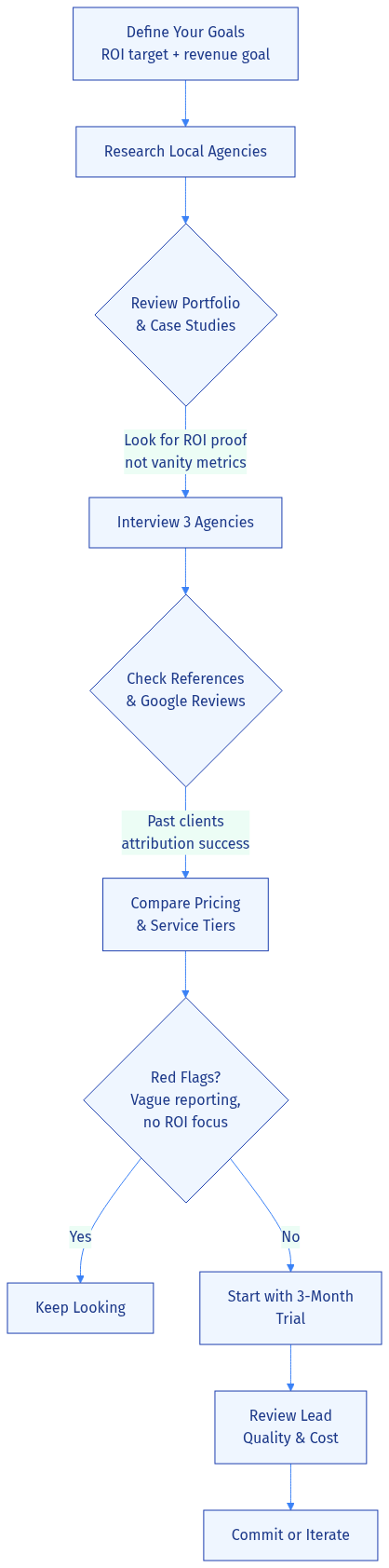
Decision workflow for selecting a professional social media agency in Sarasota: prioritize ROI proof, local expertise, and transparent reporting over creative awards.
Start with a single question in every conversation: how do you measure success? A qualified partner should answer with lead counts, cost-per-lead, and customer attribution—not follower growth or "engagement." If the answer centers on vanity numbers, that's a red flag worth taking seriously.
Other red flags are easy to spot once you know to look for them: guarantees of follower counts, promises of viral content, an inability to produce ROI case studies, or pressure to commit to large ad budgets before any strategy has been discussed. Green flags run the opposite direction—demonstrated local market knowledge, clear demographic segmentation strategies, an A/B testing mindset, integrated Google Business Profile optimization, and transparent monthly reporting built on UTM-tracked metrics.
Compare service tiers carefully. Some agencies offer organic content and management only; others add paid media management; the strongest offer full-service strategy paired with rigorous reporting. Understanding which tier matches your goals prevents both overpaying and underinvesting. A useful framework for this evaluation is available in how to evaluate agency proposals and partnerships, particularly if you're also vetting vetting social media agencies that also manage paid advertising alongside organic strategy.
Finally, resist locking into a long annual contract before you've seen results. A 90-day trial engagement with clear KPIs—cost-per-lead, lead volume, and content performance by segment—gives you real evidence before you commit further.
- References matter: Ask for 3–5 past clients in similar industries; call them and ask about lead quality and ROI, not just whether the agency is "nice."
- Agencies should be transparent about ad spend: The platform fees (Facebook ads, Google ads) should be separate from their management fees; watch out for agencies that obscure this.
- Monthly reporting is non-negotiable: You should receive a dashboard showing leads, cost-per-lead, platform performance, and content performance by audience segment.
try this: Try this yourself: Request a free 30-minute strategy call with a Sarasota agency: Ask them to review your current social media, identify demographic misalignment, propose one platform shift, and outline the expected lead-generation impact. A qualified agency should deliver several concrete, data-backed insights in that call. Start with this local growth playbook .
What This Means for Your Business
- SMB owners in Sarasota and Manatee counties who are currently treating social media as a part-time, in-house task should expect that professional agency management will cost $1,500–$5,000/month—but will typically deliver a meaningfully higher ROI than DIY efforts through proper demographic targeting, platform strategy, and lead tracking.
- Agencies must prioritize demographic alignment over platform hype; for an older-skewing Sarasota market, a Facebook-first strategy and Google Business Profile optimization will outperform TikTok and trendy platforms in lead generation and foot traffic.
- Local content and community-focused storytelling are competitive differentiators in a fast-growing region; businesses that reflect Sarasota's local identity and seasonal audience shifts will build deeper loyalty and higher engagement than those posting generic, national content.
- ROI-focused social media marketing is measurable and attributable; if an agency or in-house effort cannot produce monthly reports showing leads, cost-per-lead, and customer attribution, the strategy is failing and should be audited immediately.
- The cost of choosing the wrong agency or continuing DIY is measured in lost leads and misaligned messaging; even a modest monthly shortfall in qualified leads can represent an opportunity cost comparable to a full agency fee.
Frequently Asked Questions
Is Facebook really still relevant for social media marketing in Sarasota County?
Yes—more relevant than most trend-driven advice suggests. With an older median age and a large seasonal winter population, Facebook remains where most of Sarasota's highest-intent, highest-spending customers actively engage with local businesses and community groups.
How much should I budget for professional social media management in Sarasota?
Local agencies typically charge $1,500–$5,000 per month depending on whether the service includes only organic content or adds paid media management, A/B testing, and full attribution reporting. Compare this against the hidden cost of DIY, which often produces only a fraction of professional results.
What metrics actually prove social media is working for my business?
Leads, foot traffic, and revenue attribution—not likes or follower counts. Setting up UTM parameters, Google Analytics 4 event tracking, and CRM integration lets you trace a sale or a tour request back to a specific post or campaign.
Should my business be on TikTok if I'm targeting the Sarasota market?
For most Sarasota businesses, no. TikTok is misaligned with a market skewed toward an older demographic, and budget spent there is typically wasted unless you specifically serve a younger relocating demographic, such as a trendy café or entertainment venue.
How do I know if I should switch from a freelancer to a full agency?
If your freelancer can't show cost-per-lead data, lacks paid media expertise, or produces inconsistent posting quality, you're likely getting only a fraction of what a full-service agency delivers. A 90-day trial with a local agency, benchmarked against your current lead cost, is the clearest way to test the difference.
Keep Learning
- Social Media Marketing Agency in Sarasota & Manatee: A Local Growth Playbook — Deep dive into how Sarasota agencies build demographic-targeted campaigns, segment seasonal audiences, and track lead attribution across platforms.
- Top Digital Marketing Agency in Sarasota & Manatee County — Case studies and methodology from leading local agencies; real examples of ROI attribution, platform strategies, and cost-per-lead benchmarks.
- Web Agency Near Me: How to Choose the Right Sarasota Partner for Your Business — Framework for evaluating agency proposals, vetting references, and aligning social media strategy with overall digital marketing and SEO goals.
- Google Ads Management Bradenton: Drive Real Local Results with Data-Driven PPC — Paid media integration with social strategy; how to combine organic social posts with targeted Google and Facebook ads for maximum lead generation.
disclaimer: Nota: Las cifras son estimaciones basadas en Datos estadísticos del contexto de investigación — proyecciones demográficas locales, Datos estadísticos del contexto de investigación — estimaciones demográficas de Sarasota County. No representan datos verificables.