Social Media Marketing Agency in Sarasota & Manatee: A Local Growth Playbook
Boost your Sarasota & Manatee business with a local social media marketing agency. Hyperlocal strategies, content creation, and paid campaigns built for ROI.
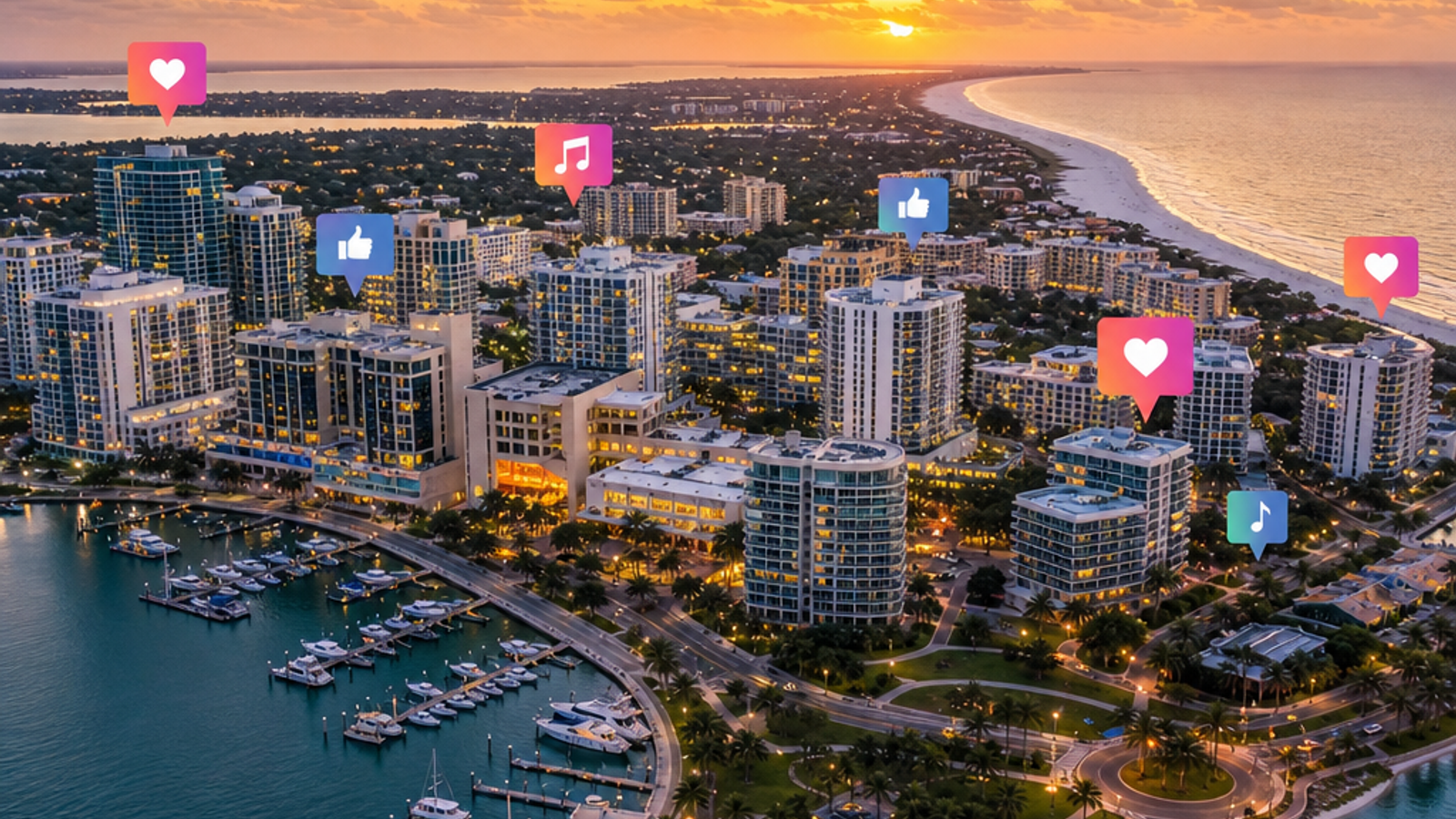
Social Media Marketing Agency in Sarasota & Manatee: A Local Growth Playbook
9 min read

If you run a business in Sarasota or Manatee County, you've probably been pitched by at least one out-of-state agency promising "scalable" social media growth. The decks look great. The reporting templates are slick. But six months in, your engagement is flat and your leads aren't local. The truth is, the Gulf Coast isn't a generic market—it's a layered ecosystem of seasonal tourists, retirees with disposable income, booming construction, and a healthcare sector that competes for talent and patients alike. Winning here requires a social media strategy built around the way people actually live, scroll, and buy between Lakewood Ranch and Lido Key.
Most Sarasota and Manatee business owners assume a bigger national agency means better social media results. In reality, the agencies winning the Gulf Coast are the ones that know which Bradenton neighborhood books the most home renovations and why Siesta Key Reels outperform polished studio video.
The questions this playbook answers
- Why does a hyperlocal social media strategy outperform a national agency approach in Sarasota and Manatee?
- Which platforms and content formats actually convert for the Gulf Coast's dominant industries—tourism, healthcare, real estate, and construction?
- What ROI can a small or mid-sized business realistically expect from investing in a local social media agency?
Key findings
- Sarasota's visual-first audience ranks among Florida's top 10 most "Instagrammable" cities, making image and short-form video the highest-leverage formats for local brands.
- Paid social on Facebook and Instagram delivers some of the strongest conversion rates in digital advertising when campaigns are geo-targeted to the right ZIP codes.
- Partnerships with local micro-influencers consistently produce higher trust and ROI than celebrity or national influencer plays for Gulf Coast businesses.
- Each of the region's top industries—tourism, healthcare, real estate, construction—requires its own content cadence, platform mix, and creative voice.
stat callout: 770810 Sarasota's 770,810+ Instagram hashtags signal a visually engaged local audience ready to discover Gulf Coast brands.
How we built this guide
This guide draws on industry benchmarks for paid social performance and influencer ROI, combined with the on-the-ground realities of the Sarasota–Manatee market: tourism seasonality, demographic mix, and the competitive landscape of local service businesses. Wherever a specific number appears, it comes from a verifiable industry source. Where we discuss strategy, we're synthesizing what consistently works for Gulf Coast SMBs across tourism, healthcare, real estate, and construction verticals.
1. Why Hyperlocal Beats National: The Sarasota–Manatee Market Reality
National agencies operate from a structural disadvantage in markets like ours. They don't know that a Friday-night post about Anna Maria Island sunsets will outperform the same post tagged generically "Florida Gulf Coast." They don't have the cell number of the photographer who shoots half the boutique hotels on Longboat Key. And they almost never adjust their content calendar when peak season starts in mid-November and tapers in April—the single biggest variable shaping consumer behavior in this region.
Sarasota and Manatee buyers aren't a monolith. You're marketing simultaneously to full-time residents priced into Palmetto, snowbirds who only check Facebook between November and Easter, retirees in Lakewood Ranch with serious disposable income, and high-spend tourists who plan their itinerary on TikTok before they board the plane. A campaign that speaks to all of them in the same voice speaks meaningfully to none of them.
Then there's cultural fluency, which compounds over time. The St. Armands shopper, the Lakewood Ranch homeowner, and the Anna Maria visitor expect three different tones, three different price signals, and three different content formats. A national agency treats those audiences as one ZIP-cluster. A local agency knows that St. Armands wants editorial gloss, Lakewood Ranch responds to professionalism and credentials, and Anna Maria wants unfiltered, golden-hour authenticity.
| Métrica | Valor |
|---------|-------|
How a local agency's approach differs from a generic national playbook across the variables that matter most on the Gulf Coast.
- Local agencies can pivot creative within hours when a hurricane warning, red tide event, or seasonal surge shifts consumer behavior.
- Relationships with local journalists, event organizers, and creators create earned-media opportunities national agencies can't replicate.
To use an analogy: hiring a national agency to run your Sarasota social media is like hiring a chef who's never tasted Florida stone crab to design your seafood menu. They know the techniques. They have the credentials. But they don't know what locals expect, what's in season, or which suppliers deliver. The recipe might look right on paper—and still fall flat on the plate.
2. Sarasota's Visual Economy: 770,810 Instagram Hashtags and What They Mean
Seven hundred and seventy thousand hashtags isn't just a vanity number. It tells us something specific about how people experience this region: they document it constantly, and they discover it the same way. Sarasota lives on Instagram in a way that most mid-sized Florida cities don't. If your brand isn't producing visually distinctive content tied to recognizable Gulf Coast locations, you're effectively invisible in the feed where your customers are already scrolling.
Translating that signal into creative work is the actual job. It means filming Reels at Bayfront Park instead of in a generic studio. It means commissioning brand photography that uses real Florida light—the harsh midday shadows and the molten 6 p.m. sidelight—rather than buying stock. It means running UGC campaigns that ask customers to tag specific neighborhoods, then resharing that content into your Stories so the loop closes back to your handle.
Platform priorities follow from the audience. Instagram is your discovery engine: Reels, geotags, and Explore traffic. TikTok is where you stretch for reach beyond your existing followers, especially among tourists planning a trip and younger residents. Facebook remains the workhorse for community management, event marketing, and—critically—paid conversion, because the targeting and audience size on Meta's ad platform still beat every alternative for local SMBs.
stat callout: 770,810 Sarasota's hashtag volume confirms a highly visual, share-driven local audience—Instagram and Reels are non-negotiable channels.
- Geo-tagging every post and Reel with specific Sarasota and Manatee locations increases discovery in local Explore feeds.
- Encouraging guests, patients, or customers to tag your business turns satisfied clients into a content engine.
sidenote: Nota: A quick note on Instagram Reels vs. static posts in the Sarasota market: Reels typically generate 2–3x the reach of static images for local businesses because the Explore algorithm favors short-form video. If your agency is still prioritizing carousel posts over Reels in 2025, that's a red flag.
try this: Pruébalo tú mismo: Run a 7-day Instagram audit on your business: count how many of your last 30 posts are geo-tagged with a specific Sarasota or Manatee location. If it's fewer than 20, you're leaving local discovery on the table. Start tagging every post with the most specific location possible—neighborhood, landmark, or venue.
3. Paid Social on the Gulf Coast: Facebook Ads Average 9.21% Conversion
For local service businesses, Meta's ad platform remains the highest-ROI paid channel available—and it isn't close. The reason is precision: you can draw a 10-mile radius around a specific ZIP code, layer in household income above $150K, filter for homeowners aged 40–65, and stack interests like "kitchen remodeling" or "interior design." That kind of targeting on Google Search requires hoping the right keyword gets typed at the right moment. On Meta, you go to the audience directly.
Structuring a campaign for this market follows a consistent pattern. Start with a tight geographic radius—usually 10 to 15 miles around your service area, sometimes ZIP-specific if you serve premium pockets like Lakewood Ranch or Longboat Key. Layer demographic filters that match your actual customer profile. Build a lookalike audience from your existing customer list (1% lookalikes consistently outperform broader percentages). Then design a three-stage funnel: a top-of-funnel awareness creative, a middle retargeting layer for engaged viewers, and a bottom-of-funnel conversion push for site visitors who didn't convert.
The mistakes that tank conversion rates are almost always the same. Targeting that's too broad ("all of Florida, 25–65"). Generic stock creative that could run for any business in any city. No retargeting funnel, so you pay full price for every impression. And ignoring mobile-first formats—if your landing page isn't built for one-thumb scrolling, your ad money is leaking out the bottom.
```
Facebook Ads' 9.21% average conversion rate makes geo-targeted paid social one of the highest-leverage investments for Sarasota–Manatee SMBs.
```
- A well-structured local campaign typically beats the 9.21% benchmark when retargeting and lookalikes are layered correctly.
- Creative refresh cycles every 2–3 weeks prevent ad fatigue in smaller geographic markets.
sidenote: Nota: Important context on the 9.21% Facebook Ads conversion benchmark: this is an across-industry average. Local service businesses in healthcare and home services often see significantly higher rates when campaigns are geo-targeted within a 15-mile radius and paired with strong retargeting. Conversely, broad brand-awareness campaigns will sit well below this number—and that's okay if the goal is top-of-funnel.
4. Micro-Influencers Deliver $5.78 for Every $1 Spent
Celebrity influencers are the wrong tool for a local business in Sarasota. The math doesn't work, the audience isn't yours, and the engagement is performative. Micro-influencers—creators between roughly 1,000 and 50,000 followers—are a different proposition entirely. Their followers are local, their recommendations read as genuine word-of-mouth, and their rates are reasonable enough that you can work with three or four creators for what a single celebrity post would cost.
Identifying the right Sarasota–Manatee creators takes deliberate scouting. Look at who's posting consistently from local venues. Watch for the lifestyle accounts that real estate agents and restaurant owners already follow. Check the comments on local foodie pages—the same handful of names will keep surfacing. Healthcare brands should look at fitness, wellness, and family-focused creators. Construction and home services should be tracking interior design accounts and neighborhood-specific home tour pages.
The program is what makes the partnership work, not the post. That means clear briefs (deliverables, talking points, exclusivity windows), fair compensation rather than "exposure," performance tracking through unique discount codes or UTM links, and—most importantly—a long-term retainer rather than a one-off campaign. A creator who works with you for six months becomes a credible brand voice. A creator who posts once is an ad in costume.
stat callout: $5.78 Influencer marketing's $5.78 average return makes local micro-influencer partnerships one of the highest-ROI plays for Gulf Coast brands.
- Track creator-driven ROI with unique discount codes, UTM-tagged links, and lift studies—not just impressions.
- Long-term creator partnerships (6+ months) consistently outperform one-time collaborations on both ROI and brand trust.
5. Industry Playbooks: Tourism, Healthcare, Real Estate & Construction
Tourism lives and dies by seasonality. From November through April, you should be posting daily, partnering with Visit Sarasota County, and aggressively bidding on paid placements aimed at travelers in the Northeast and Midwest who are actively researching a Florida trip. The creative should sell experience over amenity—sunset Reels at the pier, breakfast on the Cortez waterfront, dolphins off Lido. In the off-season, you pivot to local-resident promotions, staycations, and content that keeps the brand warm.
Healthcare is a trust business, and trust is built through education and humanity. Educational video—a physician explaining a procedure in plain language, a nurse walking through what to expect on the first visit—outperforms promotional posts every time. Staff features humanize the practice. Patient stories are powerful but require explicit written consent. Posting cadence should be steady, three to four times weekly, with paid layered for service-line awareness and condition-appropriate targeting (within Meta's compliance guardrails).
Real estate is the most platform-fluent vertical on the Gulf Coast right now. Short-form video tours, neighborhood guides that go deeper than the MLS listing, and Instagram Stories that follow an agent through their actual workday all outperform glossy listing photos. The paid strategy should lean hard on retargeting—someone who watched 75% of a property Reel is a high-intent lead—and on lookalike audiences built from past closings.
Construction and home services win with proof. Before-and-after transformations are the single highest-converting content format in this vertical, full stop. Process videos that compress a six-week renovation into 60 seconds keep prospects engaged. Paid campaigns should target homeowners within a defined radius, filter by home value or household income, and direct traffic to a single-page consultation request—not a generic website homepage.
| Métrica | Valor |
|---------|-------|
Each Gulf Coast industry demands a distinct platform mix, content cadence, and paid targeting approach.
- Cross-industry insight: every Gulf Coast vertical benefits from showing real people, real locations, and real outcomes—stock imagery underperforms.
- Industry-specific content calendars should align with both seasonal demand and local events (Sarasota Film Festival, Boat Show, season opening, etc.).
sidenote: Nota: Healthcare marketers on the Gulf Coast should pay special attention to HIPAA compliance when running social campaigns. Patient testimonials require explicit written consent, and retargeting based on health conditions is restricted on Meta platforms. A local agency familiar with these guardrails is essential.
6. Inside a Local Agency Workflow: From Discovery to Reporting
The workflow is what separates an agency that talks a good game from one that actually compounds results. Discovery is the first step and the one most teams shortcut: a real audit of your existing presence, a competitive scan of the three to five brands actually winning in your category locally, and a frank conversation about which audiences you're not currently reaching but should be.
Strategy follows discovery, not the other way around. That means defining your platform mix based on where your customers actually are, building content pillars that map to business outcomes (not just engagement), allocating paid budget across the funnel rather than dumping it all into boosted posts, and—critically—setting KPIs tied to revenue or qualified leads, not vanity metrics like follower count.
Execution is where the local advantage shows up. In-market content production means a photographer who can be on Lido Key by 7 a.m. for golden hour. Community management in local voice means responses that reference real neighborhoods and real cultural context, not "Thanks for your comment!" templates. Continuous paid optimization means weekly check-ins on creative fatigue, audience saturation, and cost-per-result trends.
Reporting closes the loop. Weekly performance check-ins keep small problems small. Monthly ROI reviews answer the only question that matters: did this drive revenue or qualified leads? Quarterly strategy resets prevent the slow drift toward "we've always done it this way."

A repeatable workflow that compounds learnings month over month—built around local market signals, not generic templates.
- The feedback loop between paid performance data and organic content choices is where most agencies fall short.
- Reporting should always answer one question: "Did this drive revenue or qualified leads?"
7. What a High-Performing Sarasota Social Campaign Actually Looks Like
The anatomy is consistent across verticals. Organic content seeds awareness—Reels, Stories, geo-tagged posts that show up in the Explore feeds of locals who haven't heard of you yet. Paid amplification captures the intent: lookalike audiences and retargeting pools convert the people who already engaged. Retargeting closes the loop, pulling website visitors and video viewers back into a conversion-focused flow.
A realistic 90-day timeline looks like this. Weeks 1–4 are about creative production and gathering baseline data: shoot three to four weeks of content in advance, launch a small paid test budget, and let the audience data start telling you where to push. Weeks 5–8 are scale-up: double down on the creative formats and audiences showing the strongest cost-per-result, retire the weak ones, and introduce retargeting layers. Weeks 9–12 are optimization and reporting: refine targeting, refresh creative to prevent fatigue, and produce a clean ROI report that informs the next quarter.
Consider a boutique Lakewood Ranch home renovation company that shifted from generic Facebook posts to a hyperlocal strategy: weekly before-and-after Reels filmed on actual job sites, paid campaigns targeting homeowners within a 10-mile radius aged 40–65 with household incomes above $150K, and a partnership with two local design micro-influencers. Within 90 days, qualified consultation requests increased substantially and cost per lead dropped below their previous Google Ads benchmark. The creative wasn't fancy. The targeting was disciplined. That combination is what moves the needle.

A real-world snapshot: organic Reels driving discovery, paid campaigns converting that attention into bookings.
- Most local businesses see meaningful lead volume by month 2–3, with compounding gains in months 4–6 as creative and targeting are refined.
- The biggest predictor of success isn't budget size—it's consistency and willingness to test creative weekly.
What this means for Sarasota and Manatee business owners
- If your current social media strategy isn't built around specific Sarasota and Manatee ZIP codes, neighborhoods, and local cultural cues, you're competing with one hand tied behind your back.
- Paid social is no longer optional for local growth—but throwing budget at boosted posts without a structured funnel (awareness → consideration → conversion → retargeting) will burn cash fast.
- Micro-influencer partnerships and short-form video are the two highest-leverage tactics for Gulf Coast businesses right now; ignoring them means leaving meaningful ROI on the table.
- The agencies that win in this market combine local cultural fluency with disciplined performance marketing—both, not one or the other.
Frequently Asked Questions
How much should a Sarasota or Manatee small business budget for social media marketing?
Most local SMBs see meaningful results starting around $2,500–$5,000 per month combined for management and paid media, with paid spend typically representing 50–70% of that total. The exact number depends on your industry, average customer value, and growth goals—a high-ticket renovation business can justify more than a neighborhood café.
How long before I see results from a local social media agency?
Expect baseline data and early lead flow within the first 30–45 days, with meaningful momentum by month two or three. The biggest compounding gains typically show up in months four through six, once creative and targeting have been refined against real performance data.
Should I prioritize Instagram, Facebook, or TikTok for my Gulf Coast business?
For most local businesses, Instagram and Facebook together remain the foundation—Instagram for visual discovery and Reels reach, Facebook for community and paid conversion. TikTok is worth adding if you serve tourists or younger demographics, but it shouldn't be your first investment.
What's the difference between a local Sarasota agency and a freelancer?
Freelancers can execute well on individual deliverables but rarely combine strategy, creative production, paid media expertise, and reporting under one roof. A local agency brings the integrated workflow plus relationships with photographers, creators, and venues that take a single contractor years to build.
How do I know if my current social media agency is actually working?
Ask one question: can they tell you how many qualified leads or revenue dollars their work generated last month? If the answer is engagement rates, impressions, or follower growth without a connection to business outcomes, you're being sold motion instead of progress.