Hiring a Screened Porch Contractor in Sarasota: A Complete Guide to Licenses, Permits & Materials
Complete guide to hiring a screened porch contractor in Sarasota. Learn about Florida licenses, building permits, material specs, hurricane codes, and critical questions to ask before signing.
Hiring a Screened Porch Contractor in Sarasota: A Complete Guide to Licenses, Permits & Materials
You're ready to add a screened porch contractor in Sarasota to your project list. Maybe it's a new structure to capture the outdoor lifestyle. Maybe your existing lanai needs repair. Either way, the contractor you hire will determine whether your investment lasts well over a decade or starts falling apart within three years. This guide walks you through exactly what separates screened porch contractors who meet Florida code from those who don't — and the questions that reveal the difference before you sign.
Before you collect a single bid, you need clear answers to four questions. Everything in this guide builds toward them:
- How do I verify that a screened porch contractor in Sarasota holds the correct Florida license for my project?
- What permits do I actually need, and who pays for them — me or the contractor?
- Why does material choice matter so much in coastal Florida, and what should I specify?
- How do I evaluate contractor reviews and references specific to Sarasota's climate and HOA rules?
Key Findings
Here's what the code, the licensing boards, and the material science actually say, before we get into the details:
- Florida's Certified Contractor or Specialty Contractor license is mandatory; verify it through DBPR (Department of Business and Professional Regulation) before signing any contract.
- Sarasota and Manatee County require building permits for new porch structures and most enclosures; skipping permits voids warranty, blocks insurance claims, and creates code violations.
- Aluminum frames with stainless-steel or hot-dip galvanized hardware prevent salt-air corrosion; fiberglass mesh (18/14 standard, 20/20 no-see-um) must be UV-stabilized for Florida sun exposure.
- A screened porch recovers approximately 75% of its cost at resale in Florida, and new structures in coastal zones cost $10,000–$35,000 depending on size, materials, and hurricane engineering requirements.
- HOA approval is separate from municipal permits; check your deed restrictions (CCRs) before starting design to avoid costly rework or removal orders.
stat callout: 75 A screened porch recovers 75% of its construction cost at resale in Florida, making it one of the highest-ROI outdoor improvements for homeowners in warm climates.
Methodology
This guide synthesizes Florida Building Code requirements, Sarasota and Manatee County permitting standards, industry material specifications for coastal climates, and common contractor evaluation frameworks used by homeowners and HOA boards in the Sarasota-Bradenton area. Data points include published cost ranges from contractor surveys, material durability studies for high-salt environments, and resale value analysis from real estate databases specific to Florida. All licensing references are current as of 2025 and sourced from Florida DBPR and county building services.
1. Why Hiring a Licensed Screened Porch Contractor in Sarasota Protects Your Investment
Florida regulates porch and screen enclosure work through two possible license categories: a Certified Contractor license, which is statewide and often covers broader structural work, and a Specialty Contractor license, which is county-registered and scoped to trades like aluminum structures and screening. Either one can legally install a screened porch in Sarasota, but the license has to actually match the scope of work. A contractor registered only for screen repair shouldn't be pulling a permit for a new post-and-beam structure with a hurricane-rated roof.
Hire someone outside the right license category — or with no license at all — and you're not just risking shoddy work. You're absorbing legal and financial liability that should belong to the contractor. If an unlicensed worker is injured on your property, your homeowner's policy may not cover it, and you could end up personally named in a claim. If the structure never gets inspected, the county can order it removed, at your expense, with no recourse against the person who built it.
Verifying a license takes less time than reading this paragraph. DBPR keeps a public, searchable database of every active contractor license in the state — name, license number, status, and any disciplinary actions on file. Search the company name before you ever schedule an in-home estimate. If the license comes back expired, suspended, or simply doesn't exist, you've just saved yourself a phone call and a much bigger headache later.
License status is only half the picture. Ask for a Certificate of Insurance showing general liability coverage — ideally in the $1–2 million range — and workers' compensation if the company employs crew members. Request to be named as an additional insured on that policy. This is a routine, no-cost request for any legitimately insured contractor, and hesitation on this point is itself worth paying attention to.
When something does go wrong on a project — and eventually something usually does — your recourse depends entirely on what you verified before signing. A licensed, insured screened porch contractor in Sarasota leaves a paper trail: a bondable license, an active policy, a permit record on file with the county. An unlicensed operator leaves none of that, which means disputes get settled in small claims court, if they get settled at all.
Think of it the way you'd think about buying insurance you hope never to use. Hiring an unlicensed contractor feels like savings today, the same way skipping coverage feels like savings — right up until the storm hits, the fastener rusts through, or an inspector shows up and finds no permit on record. That's the moment you discover whether what you bought was ever worth anything. A licensed, insured contractor isn't an added expense on top of the job; it's the safety net you're actually paying for.
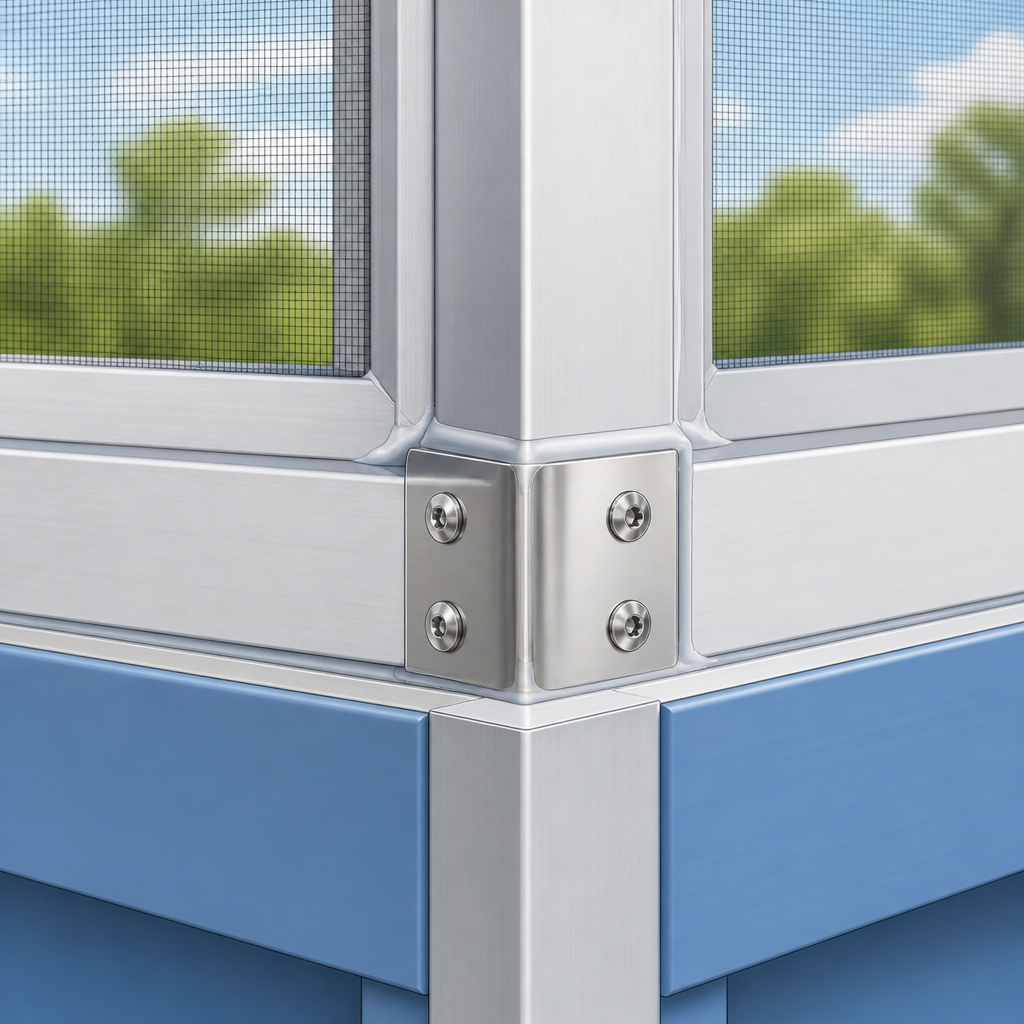
Proper material specification and fastening—hallmarks of licensed contractors—prevent corrosion and extend enclosure lifespan in Sarasota's salt-air environment.
- A licensed contractor's DBPR profile is public and searchable; verify active status and any disciplinary history before scheduling a bid.
- General liability insurance ($1–2M minimum) protects you if the contractor damages your home or injures themselves; request a Certificate of Insurance naming you as an additional insured.
- Unlicensed work voids most homeowner's insurance and disqualifies you from permit approval in Sarasota County; the cost to redo it legally often exceeds the original quote.
For a closer look at how corrosion actually destroys unprotected aluminum and fasteners over time, see our breakdown of pool cage rust repair and material failures in Lakewood Ranch — the same salt-air mechanics apply directly to porch screening hardware.
try this: Pruébalo tú mismo: Verify a contractor's license in 2 minutes: visit the Florida Department of Business and Professional Regulation (DBPR) website, click "License Search," and enter the contractor's name or license number. Note the license type, expiration date, and any disciplinary history. Do this check before scheduling the first meeting. Start your search at DBPR .
2. Building Permits and Sarasota County Code: What You Need Before Installation
Almost every screened porch project in Sarasota and Manatee County requires a building permit — the exceptions are narrow and situational. A brand-new structure needs a full permit built around engineered plans. Re-screening an existing, already-permitted enclosure sometimes qualifies for a simpler process, but that depends on zoning, flood zone designation, and whether the original structure was ever legally permitted in the first place.
Filing the permit is the contractor's job, not yours — but it becomes your problem if it doesn't happen correctly. A licensed screened porch contractor in Sarasota pulls the permit under their own license number, schedules every required inspection, and closes out the permit once the work passes final sign-off. If a contractor tells you permits "aren't necessary" for your project, or suggests you file them yourself to save a few hundred dollars, treat that as a serious warning sign, not a cost-saving tip.
New structures carry an extra requirement on top of the standard permit: hurricane-rated engineering. Florida Building Code requires wind load calculations for any new attached or freestanding structure in coastal wind zones, and Sarasota's wind speed thresholds aren't negotiable. Expect a licensed engineer's stamp on the plans before the county will issue a permit for new construction.
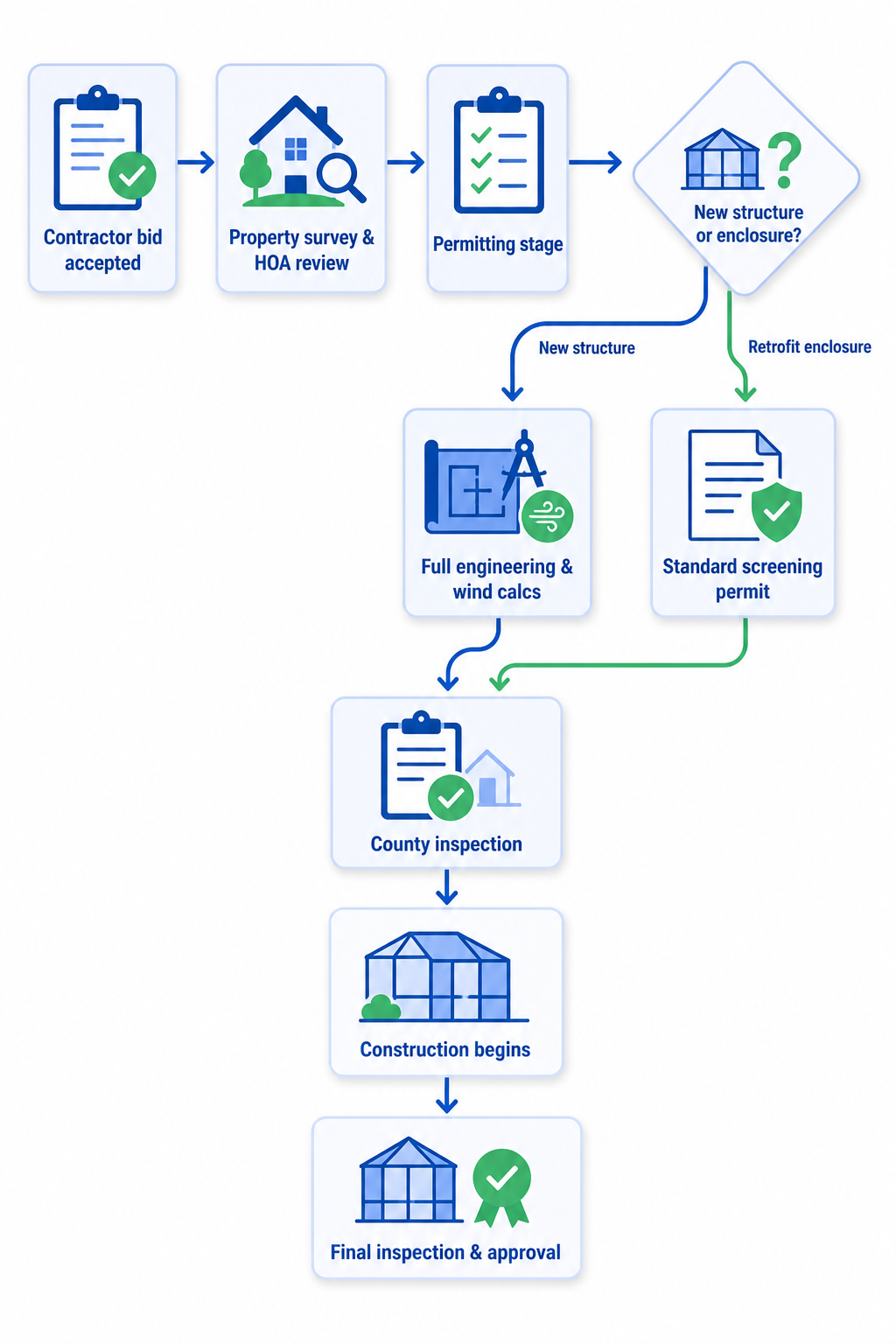
Sarasota County permitting workflow for screened porch projects: timing varies by scope, but plan 2–4 weeks for permit approval.
Inspections typically happen at two or three points in the process: a structural or framing inspection before the mesh goes on, and a final inspection once the enclosure is complete. Each one is scheduled by the contractor and conducted by a county inspector. Skipping a scheduled inspection, or building past the point an inspector expects to see progress, can trigger a stop-work order that delays everything behind it.
One distinction trips up more Sarasota homeowners than any other part of this process: HOA approval and county permits are two completely separate systems. Your association can approve your design while the county denies your permit, or the reverse. Communities like Lakewood Ranch and many Siesta Key developments run their own architectural review boards with rules about frame color, mesh opacity, and even allowable square footage — none of which the county building department checks or enforces.
- Call Sarasota County Building Services (941-861-5000) to confirm permit requirements for your specific address before contractor quotes — requirements vary by zoning and structure type.
- New porch structures in coastal Sarasota require hurricane-rated engineering; costs run $500–$2,000 for calcs, but skipping them is not an option for code compliance.
- HOA communities (Lakewood Ranch, Siesta Key, etc.) often have design review boards separate from the county; approval from the HOA does NOT waive county permits.
- A licensed contractor typically includes permit filing in the contract price; if a bid excludes it, that's a red flag and a cost you'll pay twice.
If you want to see how permitting requirements play out differently across neighboring municipalities, our guide to building permits and zoning compliance for outdoor structures in North Port walks through a comparable process.
sidenote: Nota: Avoid scheduling major screening projects between June and November if you can help it. Permit offices get backed up, contractors book out weeks in advance, and inspectors often prioritize storm-preparation work over routine final inspections during hurricane season. Winter and early spring are the fastest windows for permitting and installation in Sarasota.
3. Material Specifications for Screened Porches in Coastal Sarasota: Why Your Choice Determines Durability
Sarasota's climate is hard on building materials in a way inland Florida simply isn't. Salt carried in off the Gulf settles on every exposed surface, and combined with near-constant UV exposure and humidity, it accelerates corrosion and material breakdown on a timeline that catches a lot of homeowners off guard. Material specification here isn't a cosmetic preference — it's the difference between a porch that needs attention in five years and one that holds up for fifteen.
Mesh selection starts with a simple question: what are you actually trying to keep out? Standard 18/14 fiberglass mesh handles typical flying insects and debris and works fine on most inland properties. But if you're near water, a marsh, or mangrove habitat — which describes a lot of Sarasota — the real nuisance is no-see-ums, and standard mesh openings are too large to stop them. That's exactly what 20/20 no-see-um mesh is built for, and it's worth the premium if biting bugs have ever been a complaint at your property.
Frame material isn't really a debate in coastal Sarasota: it's aluminum, not wood. Wood framing might hold up in drier, inland climates, but in a salt-air, high-humidity environment it rots, warps, and invites termites faster than most homeowners expect. Every reputable screened porch contractor in Sarasota — and every reputable screened porch contractor in Bradenton, for that matter — will steer you toward aluminum framing for exactly this reason.
The hardware is where cheap bids cut corners you can't see until it's too late. Standard steel fasteners rust within a few years in salt air, leaving streaks down your screening and eventually failing structurally. Stainless-steel (304 or better) or hot-dip galvanized fasteners cost more upfront but don't share that failure point — this is one spec where the upgrade is simply not optional on a coastal property.
Mesh also degrades under UV exposure, independent of salt. Ask for material spec sheets showing a UV stabilization rating — ASTM D4775 is the standard reference point — before you commit to a bid. Budget, uncoated mesh can look fine on installation day and still fail years ahead of schedule once Florida sun takes its toll.
| Tipo de malla | Tamaño mesh | Mejor para | Durabilidad en costa |
|---|---|---|---|
| Fibra de vidrio estándar | 18/14 | Protección general de insectos | Moderada |
| Malla No-See-Um | 20/20 | Insectos pequeños y plagas locales | Alta |
| Resistente a mascotas | Variable | Hogares con animales | Muy alta |
Mesh and hardware options for Sarasota screened porches: trade-offs between cost, insect protection, pet durability, and salt-air longevity. Stainless-steel or galvanized fasteners are non-negotiable in coastal areas.
- Ask your contractor: "What gauge aluminum frame do you use, and are all fasteners stainless-steel 304 or better?" Low-quality aluminum and steel fasteners rust within 3–5 years in salt air.
- No-see-um mesh (20/20) is worth the 30–40% cost premium if you're near water, marshes, or have a history of biting-bug complaints; standard mesh won't stop them.
- UV-stabilized fiberglass mesh lasts longer than un-coated alternatives; ask for material spec sheets from your contractor showing UV rating (typically ASTM D4775).
- Budget an extra 10–15% for high-quality materials if your property is within 1 mile of water; salt spray accelerates degradation of cheap components.
For more detail on how aluminum framing and wind-code specifications work together in coastal construction, see our aluminum enclosure materials and wind-code guide for Bradenton — the structural principles carry over directly to screened porch framing.
A cautionary example: A Lakewood Ranch homeowner accepted a $9,000 bid to screen an existing rear porch. The contractor was unlicensed and skipped the HOA design-review process entirely. Six months after the new owner moved in, three problems surfaced at once: the screening violated HOA color rules and triggered a removal order, the aluminum frame fasteners were already rusting because they weren't stainless steel, and no building permit had ever been pulled — which voided the homeowner's insurance coverage for that structure. Fixing it meant hiring a licensed contractor to tear out and rebuild the entire project correctly, at a cost of $15,000. Total cost for a porch that should have run $9,000–$12,000 the first time: $24,000.
4. Cost Breakdown for Screened Porch Installation in Sarasota: What You'll Actually Pay
Pricing for screened porch work in Sarasota splits into two very different categories, and conflating them is where a lot of budget confusion starts. Retrofitting screening onto an existing porch or lanai structure is a relatively contained project. Building an entirely new screened structure from the ground up is a construction project with engineering, framing, and permitting requirements layered on top of it.
Cost drivers compound quickly once you get into specifics: square footage, mesh and hardware grade, whether engineering and hurricane-code calculations are required, proximity to water (which pushes you toward premium materials), and whether your HOA requires a specific aesthetic that limits your material choices. A simple 150 sq ft retrofit and a 400 sq ft new structure with full engineering aren't the same project, even though both get called a "screened porch."
On most retrofit jobs, materials and labor run roughly comparable. On new structures, labor, permitting, and engineering can represent a larger share of the total bid than the raw screening materials themselves.
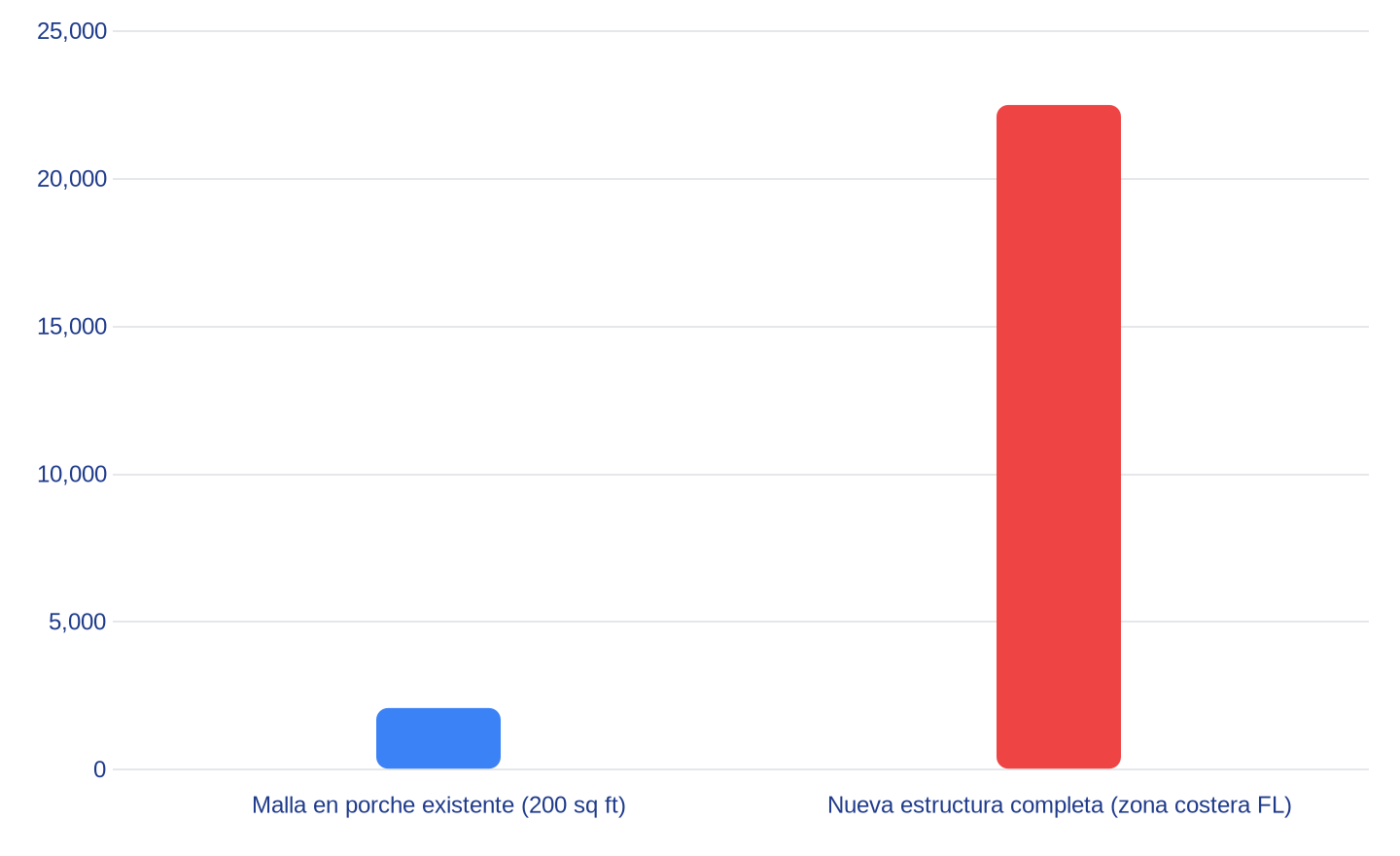
Cost comparison: retrofitting an existing porch with screening ($2,085 avg for 200 sq ft) vs. building a new screened structure in coastal Sarasota ($10,000–$35,000). New structures cost more due to engineering, permitting, and hurricane-code compliance.
The costs that catch homeowners off guard usually aren't the screening itself — it's permits, engineering fees, site prep, and inspection scheduling that an incomplete bid leaves out. A bid that looks 20% cheaper than everyone else's is worth a second look at exactly what's included and what isn't.
On the value side, a screened porch is one of the stronger outdoor investments available to Florida homeowners: it recovers roughly 75% of its construction cost at resale, which outperforms a lot of comparable home improvements. That return holds up best if you stay in the home long enough to amortize the upfront cost — five years or more — and only if the work was done to code, since a removal order or insurance dispute can erase the resale value entirely.
- Retrofit screening averages $2,085 for 200 sq ft nationally, but Sarasota coastal properties typically run $2,500–$3,500 due to material upgrades and salt-air specs.
- New structures start at $10,000 for small, simple designs; full 400+ sq ft rooms with hurricane engineering and all permitting run $25,000–$35,000 in coastal zones.
- Always ask: "Does your quote include permits, inspections, engineering (if required), and site cleanup?" If the answer is no, add 15–25% to the bid.
- A screened porch returns approximately 75% of its cost at resale in Florida, making it a strong investment if you stay 5+ years; shorter timeframes reduce ROI impact.
If you're weighing a screened porch against other outdoor upgrades, our pool deck pavers cost guide for North Port breaks down pricing for another high-ROI outdoor project in the same region.
sidenote: Nota: Some contractors offer 12–24 month financing for larger projects ($15,000 and up). Always confirm whether the contractor works with a third-party lender or finances the loan directly themselves. Third-party financing, through lenders or affiliated financing companies, is safer because it separates your payment risk from the construction itself. Never prepay a contractor's personal loan.
5. The Essential Contractor Evaluation Checklist: 8 Questions That Reveal Everything
By this point you know what to look for in principle. In practice, the fastest way to filter contractors is to ask the same eight questions of every bid you collect, and pay close attention to how specifically — or how vaguely — each one gets answered.
| Question to Ask | Red Flag Response | Green Flag Response | Why It Matters |
|---|---|---|---|
| Can you provide your DBPR license number and current status? | Hesitation, vague answer, 'we're between licenses' | Specific license # offered; verifiable on DBPR site within 60 seconds | Confirms legal authority to work in Florida; unlicensed contractors expose you to liability |
| Does your quote include permit filing and inspections? | 'Permits aren't needed' or 'that's your job' | 'Permit filing included; we coordinate inspections with county' | Permits are mandatory in Sarasota; contractor should handle this |
| What mesh type do you recommend for our location, and why? | 'Doesn't matter, they're all the same' or generic answer | Specific recommendation (e.g., '20/20 no-see-um because you're near marsh') with material spec sheet | Shows climate knowledge and customization; reveals whether they understand salt-air and local insects |
| What is your warranty on labor and materials? | 'No warranty' or vague commitment | Specific: e.g., '2 years labor, 5 years on frame, 10 years on mesh' | Warranties protect you post-installation; short or missing warranties indicate low confidence |
| Can you provide three recent Sarasota-area references? | Reluctance, out-of-area refs, or 'can't share' | Names, addresses, phone numbers; agrees to contact | Local references verify past performance in your climate; out-of-area refs may not reflect coastal expertise |
| Have you worked with HOA approval in our community? | 'HOA doesn't matter' or dismissive tone | 'Yes, familiar with [community name] design review; we'll submit for you' | HOA approval is separate from permits; skipping it results in removal orders and wasted money |
| What are your payment terms? | 50%+ down before any work; no written contract | 30% deposit, balance due upon completion; written contract with milestone clauses | Large deposits and no contract are classic contractor red flags; protects your cash flow |
| Do you handle site cleanup and debris removal? | 'That's extra' or unclear scope | 'Included in the quote; we remove all debris daily' | Unclear cleanup scope leads to surprise costs and neighborhood complaints |
Eight contractor questions that separate qualified screened porch operators from bargain contractors. Use this table during your initial calls to filter out red flags early.
Notice the pattern in the red-flag column: vague, dismissive, or deflecting answers. A contractor who knows their business answers these questions with specifics — a license number, a named mesh product, a warranty duration measured in years, not "we stand behind our work." Specificity is the tell.
Local references matter more than raw review counts. Call at least two of the references a contractor gives you and ask directly: did the project finish on budget and on schedule, would they hire the contractor again, did anything surface after the crew left. A contractor who's done solid work in Sarasota's climate for several years will have references happy to answer those questions.
- Get everything in writing: quote, material specs, warranty, timeline, payment schedule, and the contractor's license and insurance information. Verbal agreements are worthless if disputes arise.
- Contact at least two references directly; ask specifically: "Did the project stay on budget and timeline? Would you hire them again? Any issues during or after completion?"
- If a contractor hesitates to provide references or DBPR license info, walk away immediately. Transparency is the bare minimum for a qualified operator.
- Check Google reviews and the Better Business Bureau for pattern complaints (e.g., "didn't pull permits," "mesh tore within a year," "didn't show up for inspections").
The same evaluation logic applies across outdoor construction trades — our guide to contractor selection and quality assurance for pool construction in Sarasota-Bradenton covers a parallel vetting process worth reviewing.
try this: Pruébalo tú mismo: Create a simple contractor evaluation spreadsheet using the eight questions above. List each contractor in rows, mark their responses as red or green flags, and note reference contact info as you go. Comparing bids side by side like this forces an apples-to-apples comparison and surfaces disqualifiers early, before you're emotionally invested in a design or a price.
6. Front Entry Enclosure and Porch Screen Installation in Sarasota: Design & Code Compliance
Front entry enclosures are a different animal than rear porch screening, even though the materials look similar. A rear screened porch is primarily a living space; a front entry enclosure — sometimes called a vestibule — sits at your main entrance and has to balance weather protection with code requirements around egress and visibility.
Because an entry enclosure sits at a required exit path, it has to maintain clear egress and adequate ventilation under Florida Building Code. Ask your contractor directly how their design handles both — a front entry porch screen installation in Sarasota that narrows or blocks the exit path from your front door is a code violation waiting to be flagged at inspection.
Front-facing structures also draw more HOA scrutiny than rear porches, simply because they're visible from the street. Communities like Lakewood Ranch typically specify frame color — often limited to white or bronze anodized aluminum — and mesh opacity as part of their design review. Get that approval locked in before the contractor orders materials; reordering custom-color framing after a rejected design adds weeks and cost you didn't budget for.
Front entries also take weather head-on in a way rear porches protected by roof overhangs often don't. Specify heavy-duty hinges, door closers, and weather-stripping designed for direct exposure, and make sure the design integrates with your home's existing roofline and trim instead of looking bolted on as an afterthought.
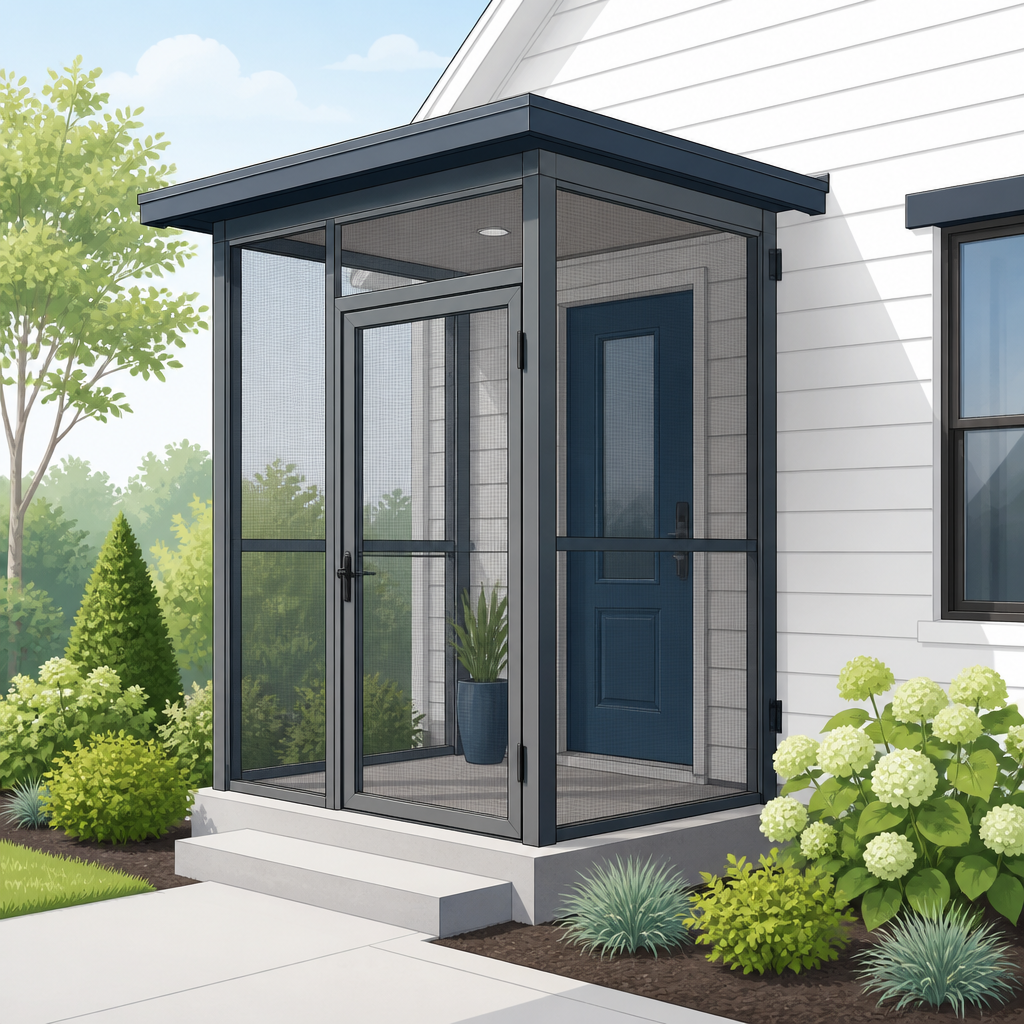
A properly installed front entry enclosure provides weather protection and insect barrier while maintaining code compliance for egress, ventilation, and HOA aesthetics.
- Front entry enclosures must maintain egress (exit pathway) and ventilation; ask your contractor how they meet these code requirements for your design.
- HOA boards often dictate frame color (typically white or bronze anodized aluminum) and screen mesh opacity; confirm design approval before contractor orders materials.
- Front enclosures take weather head-on; specify heavy-duty hinges, closers, and weather-stripping to prevent water infiltration and wear.
- A front entry screen installation typically takes 3–5 days for a single entry; avoid scheduling around hurricane season (June–November) or permitting delays.
What This Means for Sarasota-Bradenton Homeowners
Pull all of this together and the takeaways for anyone managing a screened porch project in Sarasota-Bradenton come down to a few practical realities:
- Saving $2,000–$5,000 upfront by hiring an unlicensed contractor typically costs $8,000–$15,000 in rework, code violations, HOA removal orders, and insurance disputes. Qualified contractors are not expensive; unqualified ones are.
- Florida's coastal climate and salt-air environment are brutal on materials; mid-grade mesh and fasteners fail in 3–5 years. Premium material specs add 15–20% to cost but extend lifespan to 10–15 years, making them economically superior.
- Permit delays and HOA approval are not the contractor's problem alone — they're the homeowner's problem if you don't plan for them. Budget 4–6 weeks minimum for permitting and approval before construction can start.
- A screened porch is a 10–15 year investment in Florida; resale value recovery is strong (75% ROI), but only if it's installed to code, maintains aesthetic consistency with the neighborhood, and doesn't trigger code violations. Cutting corners destroys that value.
- Screened porches near water or marsh are high-maintenance environments. Choosing 20/20 no-see-um mesh and stainless hardware adds cost upfront but eliminates years of complaints about biting insects and rust staining.
The same logic — quality materials and licensed installation protecting resale value — applies to other high-ROI outdoor upgrades in the region, like the finish choices covered in our pool resurfacing guide for Venice.
Keep Learning
Aluminum Pool Enclosure in Bradenton: Materials, Wind Codes & Installation Guide Dive deeper into hurricane-rated aluminum enclosures, wind-code specifications, and material durability for Bradenton's coastal climate—principles that directly apply to screened porch structural engineering.
Pool Cage Rust Repair in Lakewood Ranch: A Complete Diagnosis & Fix Guide Learn how salt-air corrosion damages screening structures and how to identify rust problems early. The diagnostic techniques and material failures covered here are directly relevant to porch enclosure maintenance.
Pool Screen Repair Cost in North Port, FL: 2026 Price Guide Understand common screening repair costs and permitting requirements across different Florida municipalities. Repair patterns and code insights help you anticipate maintenance for your screened porch.
Frequently Asked Questions
Do I need a permit to screen an existing porch in Sarasota, or only for new structures?
<p>In most cases, yes — even retrofitting screening onto an existing porch requires a permit, though the process is typically simpler than for a new structure. The exact requirement depends on your zoning, flood zone designation, and whether the original porch was ever legally permitted. Conf