Pool Deck Pavers in North Port: Materials & Costs 2026
Compare the best pool deck pavers for your North Port home. Explore 2026 costs, materials like travertine & porcelain, and what to expect for Florida's climate.
Pool Deck Pavers in North Port: Materials & Costs 2026
Most North Port homeowners assume all pool deck pavers perform the same—until they step barefoot onto dark concrete on a 95°F day. The material you choose determines safety, comfort, longevity, and your wallet's long-term health. Light travertine stays roughly 25°F cooler than dark concrete, meets Florida code without special treatments, and outperforms concrete pavers in coastal climates—yet many contractors still push cheaper options without explaining the true cost of that choice.
Pool deck pavers in North Port aren't just decorative. They're a code-compliance requirement, a barefoot safety zone, and a 20+ year investment exposed to relentless Florida sun, salt spray, and moisture. This guide compares the three materials dominating the Sarasota–North Port market—concrete, travertine, and porcelain—by upfront cost, performance in your climate, maintenance burden, and real-world durability. By the end, you'll know exactly which option matches your priorities and budget.
Three Questions Every North Port Homeowner Asks Before Choosing Pavers
- What is the best paver material for a pool deck in North Port, Florida?
- How much do pool deck pavers cost to install in the North Port/Sarasota area?
- What are the Florida code requirements for pool deck surfaces?
Key Findings
- Travertine is the most recommended pool deck material in Southwest Florida because it stays cooler underfoot, resists slip hazards naturally, and performs well in coastal salt environments—without premium pricing over concrete.
- Installed paver costs in the Sarasota–North Port area (2026) span $13–$32/sq ft depending on material; travertine ($20–$26/sq ft) offers the best cost-to-comfort ratio for most homeowners.
- Florida Building Code mandates pool wet decks use nonabsorbent, slip-resistant materials; wood is prohibited. Porcelain requires R11 or R12 anti-slip certification; travertine and light concrete meet code naturally.
- On a 95°F day, light travertine surfaces reach 110–120°F while dark concrete exceeds 135°F—a 25°F difference that is critical for barefoot safety and usability.
- Porcelain offers the lowest maintenance (non-porous, stain-resistant, algae-proof) but requires upfront anti-slip verification and premium installation; best for modern aesthetics and zero-tolerance homeowners.
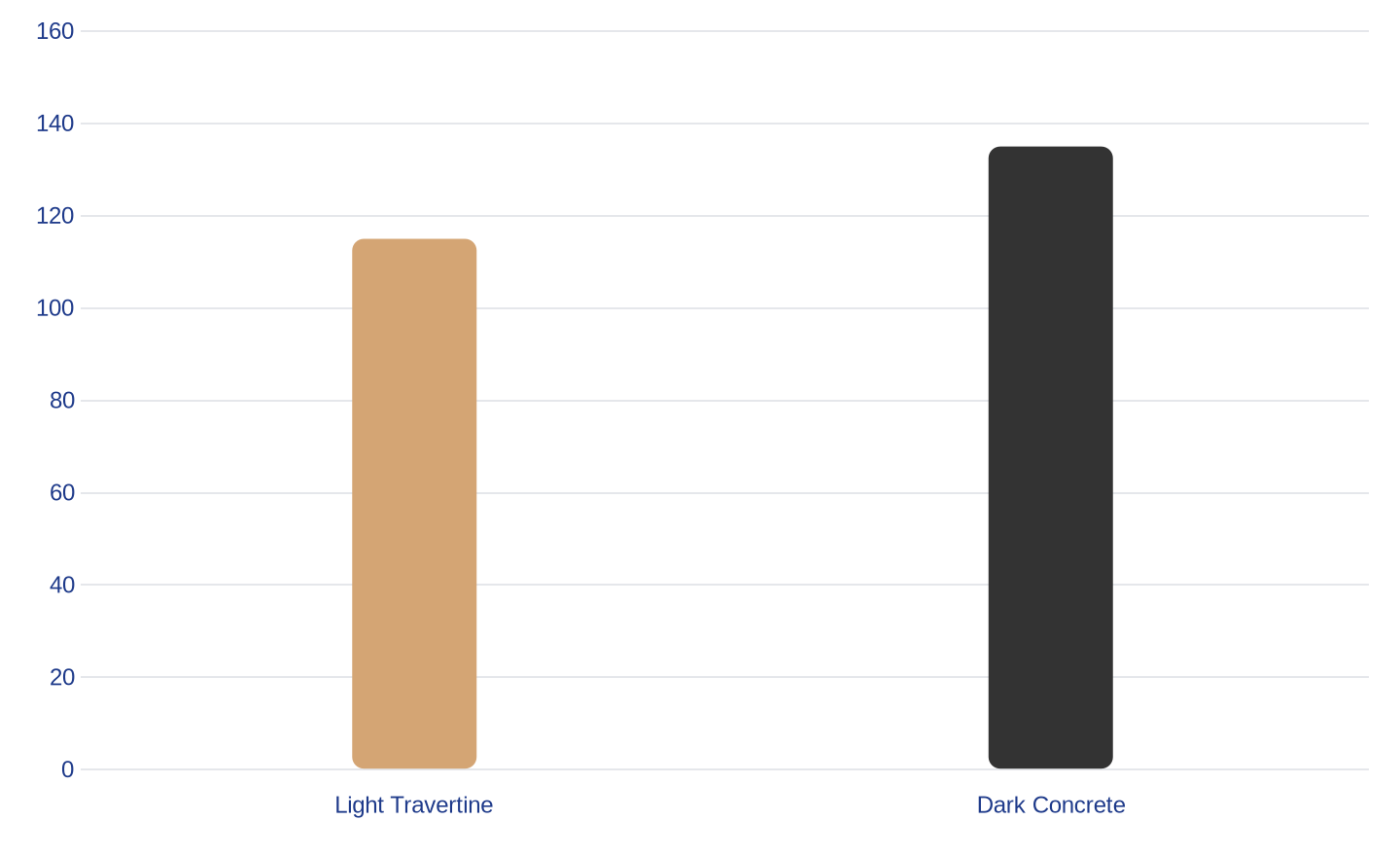
Surface temperature comparison on a typical 95°F Florida day: light travertine stays dramatically cooler than dark concrete, translating directly to barefoot comfort and safety around your pool.
Methodology
This guide synthesizes current 2026 pricing data from local North Port and Sarasota contractors, Florida Building Code Chapter 4 (Pools) requirements, material performance data from manufacturers, and climate data specific to Southwest Florida's salt-air and high-temperature environment. All cost ranges reflect installed prices (materials + labor); individual quotes will vary based on deck size, site access, substrate condition, and contractor markup. Slip-resistance ratings reference ASTM D2047 and D3359 standards. Temperature data comes from field measurements and published material studies in subtropical conditions.
1. Pool Deck Pavers in North Port: Why Material Choice Determines Your ROI
Pool deck pavers are not cosmetic. They anchor safety, code compliance, and long-term value in a climate that doesn't forgive shortcuts. North Port's combination of 95°F+ heat, persistent salt spray drifting in from the Gulf and Myakka estuary, seasonal algae growth, and heavy summer rainfall stresses inferior materials within as little as three to five years—a timeline that catches a lot of homeowners off guard when they compare it to the 15-year sales pitch they were given.
The paver you choose today determines more than curb appeal. It sets your barefoot comfort level in July, your maintenance frequency through the rainy season, your slip risk during peak pool months, and ultimately your replacement timeline. Homeowners who treat pool deck pavers in North Port as a pure budget line item often end up paying twice: once for the installation, and again a few years later for the redo.
It's also worth noting that contractor bids for the same square footage can vary by 30–40% across materials. That spread isn't just labor markup—it reflects real differences in durability and liability. Cheaper doesn't automatically mean better value; it often means a shorter runway before you're back in the market for a new deck.
- Dark pavers create liability: surface temps above 130°F can cause foot burns and pool avoidance during peak summer.
- Nonabsorbent requirement is non-negotiable: porous materials trap moisture, promote algae, crack under freeze-thaw (rare in North Port but possible in winter), and fail code inspection.
- HOA communities often have specific material or color restrictions—verify CCRs before requesting bids.
Before you finalize any deck design, it's worth understanding how North Port Building & Zoning permit requirements for pool work intersect with paver selection, since permitting and material choice are evaluated together during inspection.
try this: Try it yourself: Request a thermal imaging comparison from your contractor: ask them to photograph your candidate paver materials (concrete, travertine, porcelain samples) side-by-side in direct sunlight at peak afternoon temperature. Compare surface temps and barefoot comfort firsthand—many North Port contractors can do this for free during the bid phase.
2. Travertine Pool Deck Pavers in Florida: The Performance Sweet Spot for Southwest Florida
Travertine is a sedimentary limestone formed in warm mineral spring deposits. It's naturally porous yet becomes effectively nonabsorbent once sealed, and its crystalline texture gives it built-in slip resistance that other materials have to manufacture. For a travertine pool deck in Florida, that combination of natural grip and thermal comfort is exactly why it dominates recommendations across Southwest Florida.
Here's why it excels specifically in North Port: it stays cooler underfoot thanks to its thermal mass, it's naturally slip-resistant enough to meet Florida code without added treatments, it holds up well against salt exposure (a real concern this close to coastal Sarasota County), and it carries a warm, neutral aesthetic that fits both older and newer home styles.
Color selection matters more than most homeowners realize. Travertine comes in shades ranging from light cream to warm beige, and lighter shades are essential for heat mitigation—dark travertine in direct sun defeats the entire purpose of choosing the material. Installed cost in the Sarasota–North Port area runs $20–$26 per square foot (materials plus labor), with premium sourcing and finish work pushing some projects to $28/sq ft.
Expect a lifespan of 15–20+ years in Florida's climate if the deck is sealed every two to three years. When travertine fails prematurely, it's almost always traceable to inadequate sealing or poor substrate drainage—not the material itself.
stat callout: 25 Travertine's natural thermal mass keeps surface temps significantly lower, making it safer and more comfortable for barefoot use during peak Florida heat.
- Travertine is softer than porcelain or granite—surface etching from acidic spills (lemon juice, vinegar, pool chemicals) is cosmetic but visible. Avoid storing acidic cleaners nearby.
- Sealing is critical: apply penetrating sealer at install, then every 2–3 years. Budget $200–$400 per 500 sq ft for professional resealing.
- Travertine dust (a fine white powder) can persist during install and first rain; not a defect, but plan for minor cleanup.
sidenote: Nota: Travertine sourcing varies by region: North Port-area suppliers typically stock Turkish, Mexican, and Argentinian travertine. Turkish travertine is denser and more salt-resistant (preferred for coastal Sarasota County), while Mexican travertine is softer and warmer in tone. Ask your contractor's material source before ordering—it affects durability and cost by 10–15%.
3. Porcelain Pavers vs. Travertine for Pool Decks: A Durability & Maintenance Comparison Table
Porcelain pavers are fired ceramic—vitrified, non-porous, and essentially immune to staining, algae growth, and moisture absorption. For coastal North Port properties dealing with year-round humidity and salt spray, that non-porous quality is a genuine advantage over anything that needs periodic sealing.
The cost premium is real: porcelain runs $22–$32/sq ft installed versus travertine's $20–$26/sq ft. But that gap narrows over time because porcelain requires zero sealing and minimal upkeep across its 20+ year lifespan, which changes the math for homeowners planning to stay put.
One point that trips people up: slip resistance is NOT automatic with porcelain. You have to verify an R11 or R12 rating before purchase, and many manufacturers now offer pool-specific lines with textured finishes built for exactly this use case. Skipping this verification is one of the most common and costly mistakes in porcelain pool deck installs.
Installation complexity runs higher too—porcelain needs leveling compound, proper drainage planning, and installers who've actually done this kind of work before. Mistakes here show up as uneven surfaces and real tripping hazards, not just cosmetic flaws. And despite its reputation for performance, porcelain's main weakness is thermal: light-colored porcelain still reaches 115–125°F on a 95°F day. That's better than dark concrete, but warmer than travertine.
| Material | Low ($/sq ft) | High ($/sq ft) | Best For |
|---|---|---|---|
| Concrete Pavers | 13 | 16 | Budget-conscious homeowners |
| Travertine | 20 | 26 | Heat mitigation + aesthetics |
| Porcelain | 22 | 32 | Durability + modern finish |
Travertine vs. porcelain for North Port pool decks: travertine wins on comfort and sealing flexibility, while porcelain dominates durability and stain-free aesthetics. Choose based on your climate comfort priority and maintenance tolerance.
- Porcelain is harder and more brittle than travertine—impact from dropped tools or furniture can chip edges. Use protective padding for deck loungers.
- Anti-slip textured porcelain can trap dirt and algae spores in grooves if not pressure-washed monthly; budget time or contractor visits.
- For HOAs with strict architectural guidelines, porcelain's modern finishes (matte, satin, textured) often satisfy contemporary design requirements better than travertine.
4. Concrete Pavers for Pool Decks: Budget Reality & Florida Code Compliance
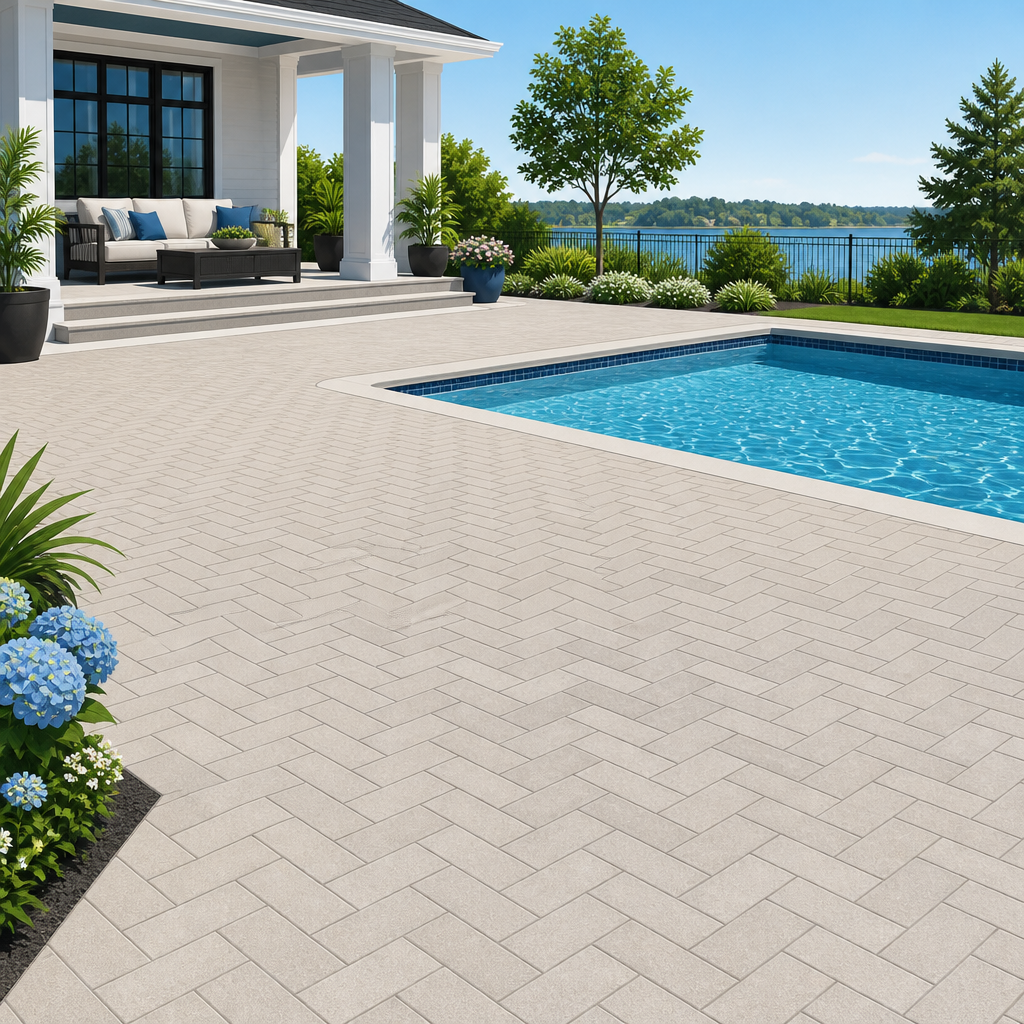
Light-colored concrete pavers remain the most affordable pool deck option in North Port, but material selection (lighter colors are mandatory) and sealing frequency are critical for long-term performance.
Concrete pavers are the budget entry point at $13–$16/sq ft installed. They're easy to replace individually if cracked, widely available from local suppliers, and they do meet Florida Building Code slip-resistance and nonabsorbent requirements—but only if properly sealed and finished. This is where a lot of patio pavers North Port projects go sideways: the material is fine on paper, but the execution determines whether it actually performs.
Color is not negotiable here. Light gray, tan, or ivory concrete pavers stay in the 120–130°F range on a hot day, while dark gray or charcoal pavers exceed 135°F and create a genuine barefoot safety hazard during peak summer. If a contractor shows you a beautiful charcoal sample without mentioning this, that's a red flag.
Sealing isn't optional for durability, either. Concrete is porous and will absorb saltwater, algae spores, and pool chemicals if left unsealed. Unsealed concrete tends to crack, stain, and turn slippery within two to three years—a far cry from what most homeowners expect from a "budget" choice.
Code also requires a minimum slope of at least 1% on paver-type decks to prevent standing water. Improper grading remains the number one cause of premature failure and algae blooms on concrete decks in this market. With proper sealing and light coloring, expect 8–12 years of service; darker options or neglected sealing can cut that down to 5–7 years.
- Concrete pavers are most vulnerable to salt spray (Sarasota County coastal areas): efflorescence (white powdery deposits) is cosmetic but signals water ingress. Use salt-resistant sealers.
- Resealing concrete every 1–2 years is more frequent than travertine, adding $150–$300 annually for a 500 sq ft deck—factor this into your true cost of ownership.
- If your budget is tight and heat mitigation is not a priority (shaded deck, limited barefoot use), light concrete pavers are a defensible choice; just commit to sealing discipline.
sidenote: Nota: Concrete pavers and pool chemistry: chlorine, salt, and pH imbalance accelerate concrete degradation. If you maintain pool chemistry within recommended ranges (pH 7.2–7.8, chlorine 1–3 ppm), concrete lifespan improves by 2–3 years. Poor pool maintenance + cheap concrete = 5-year failure. This is why HOAs with lax maintenance often require travertine or porcelain.
5. Florida Pool Deck Code Requirements: What North Port Inspectors Will Verify
Florida Building Code Chapter 4 (Pools) mandates that pool wet decks use nonabsorbent materials—wood, unsealed concrete, and porous brick are all prohibited outright. Slip resistance is measured by coefficient of friction (COF), and wet decks need a minimum ASTM D2047 rating of 0.6 or higher. Travertine naturally clears this bar; porcelain needs certification; concrete needs proper sealing and surface texture to qualify.
Slope is another non-negotiable: a minimum 2% slope away from the pool for monolithic decks, or 1% for paver-type decks, to shed water and prevent the standing pools that breed algae and create slip hazards. Coping—the edge trim around the pool—must also be nonabsorbent and slip-resistant, typically travertine or porcelain since wood coping is flatly code-prohibited.
Deck clearance requirements also come into play: most zones require a minimum of 10 feet of deck space around the pool, though you'll want to verify this with North Port Building & Zoning for your specific lot and setback situation.
stat callout: 2 Florida Building Code mandates strict slope requirements to prevent standing water, algae growth, and structural damage. Verify slope at inspection or risk costly rework.
- Code violations trigger costly rework and insurance red flags. Hire a contractor with verifiable North Port pool project experience; ask for a past inspection sign-off.
- HOA pools have additional restrictions: many Sarasota County HOAs require specific paver colors, finishes, or brands. Review CCRs before ordering materials.
- Permits are required before deck work in North Port; typical turnaround is 5–7 days for review. Budget permit fees ($300–$600) into your project cost.
For the full permit process specific to pool-adjacent structures, see this breakdown of North Port Building & Zoning contact and permit process for pool structures.
try this: Try it yourself: Contact North Port Building & Zoning (239-993-5000) and request a copy of the specific pool deck requirements for your address. Some North Port neighborhoods have micro-zoning restrictions (setbacks, slope, materials) beyond the base code; knowing this before design saves rework fees.
6. Installation Costs Breakdown: Labor, Materials & Hidden Fees for North Port Pool Pavers
Total installed cost averages $13–$16/sq ft for concrete (labor and materials combined), $20–$26/sq ft for travertine, and $22–$32/sq ft for porcelain across the North Port–Sarasota market as of 2026. But those headline numbers hide a lot of variance worth understanding before you sign anything.
Labor cost swings are driven by several factors: larger decks generally see lower per-square-foot labor costs, poor existing drainage or old concrete removal adds rework fees, pattern complexity matters (herringbone runs $2–$3/sq ft more than running bond), and contractor experience level shows up directly in the quote.
Substrate prep is the piece homeowners most often underestimate. If your existing deck has poor drainage or uneven grading, expect $5–$10/sq ft for corrective work—and skipping this step is a near-guarantee of failure within three to five years, regardless of which paver you chose.
| Line Item | Cost Range | Notes |
|---|---|---|
| Materials: Concrete pavers | $6–$8/sq ft | Light colors only; dark pavers will overheat |
| Materials: Travertine | $12–$16/sq ft | Includes sourcing and initial sealing |
| Materials: Porcelain | $14–$20/sq ft | Verify R11/R12 slip rating; premium finishes add 20–30% |
| Labor: Removal (old deck) | $3–$6/sq ft | Haul-away and disposal; concrete removal is labor-intensive |
| Labor: Substrate prep (base, drainage, grading) | $2–$4/sq ft | Critical for slope compliance and longevity; don't skip |
| Labor: Paver installation | $4–$8/sq ft | Varies by pattern complexity (running bond vs. herringbone); travertine labor is higher due to cutting |
| Sealing (initial application) | $1–$2/sq ft | Travertine and concrete require penetrating sealer; porcelain does not |
| Permitting & inspection | $300–$600 | North Port Building & Zoning; non-negotiable |
| Contingency (10–15%) | 5–10% of total | For substrate issues, drainage rework, or unexpected haul costs |
Typical installed cost breakdown for North Port pool deck pavers (per square foot and fixed fees): labor and substrate prep often exceed material costs. Travertine labor is 20–30% higher due to cutting and sealing expertise required.
- Get multiple quotes and ask each contractor to itemize labor, materials, and prep work separately. Quotes that lump everything into a single $/sq ft figure may hide corners cut elsewhere.
- Contractor insurance is essential: ensure your installer carries general liability and workers' compensation. Request proof before signing; pool deck work has high injury risk.
- Warranty language varies: most contractors guarantee labor for 1 year and material durability for 3–5 years. Travertine manufacturers (Daltile, MSI) often offer 10-year warranties on sealing if installed by certified pros.
sidenote: Nota: Substrate surprises: many North Port homes built in the 1980s–1990s have poor under-deck drainage or existing concrete that is thinner than current code requires. Contractors sometimes discover this mid-project, adding $2,000–$5,000 for substrate repair. Request a pre-bid site visit and ask contractors if they anticipate any rework; this is a legitimate contingency, not a red flag.
7. Maintenance Schedules & Long-Term Cost of Ownership: Which Material Wins Over 20 Years?
Concrete pavers demand resealing every 1–2 years to prevent staining, algae, and deterioration in Florida's high-moisture, salt-spray environment—budget $200–$400 per 500 sq ft per reseal cycle, which adds up to $1,000–$2,000 over a decade. Travertine needs sealing less often, every two to three years, plus occasional acid-etch repair, putting annual maintenance at roughly $300–$600 for a 500 sq ft deck.
Porcelain is the outlier on the low end: 2–4 pressure washes per year to keep algae out of textured grooves, plus an annual inspection for cracked grout, but no sealing or chemical treatments at all. That keeps annual cost around $100–$300.
Replacement timelines follow the same pattern—concrete typically fails at 8–12 years (sooner if sealing is neglected), travertine lasts 15–20+ years, and porcelain exceeds 20 years with minimal visible degradation. Looking at the full picture—install, maintenance, and eventual replacement over 20 years for a 500 sq ft deck—concrete lands around $15,000–$18,500, travertine around $18,000–$19,500, and porcelain around $16,000–$17,000.
Think of it like choosing tires for a car. Cheap concrete pavers are like budget tires: they get you moving, but frequent re-sealing (like tire rotations) and early replacement add up fast. Travertine is like all-season tires: solid performance across conditions with moderate maintenance. Porcelain is like premium tires: higher upfront cost, minimal maintenance, and they outlast the car—or in this case, outlast your typical homeownership timeline.
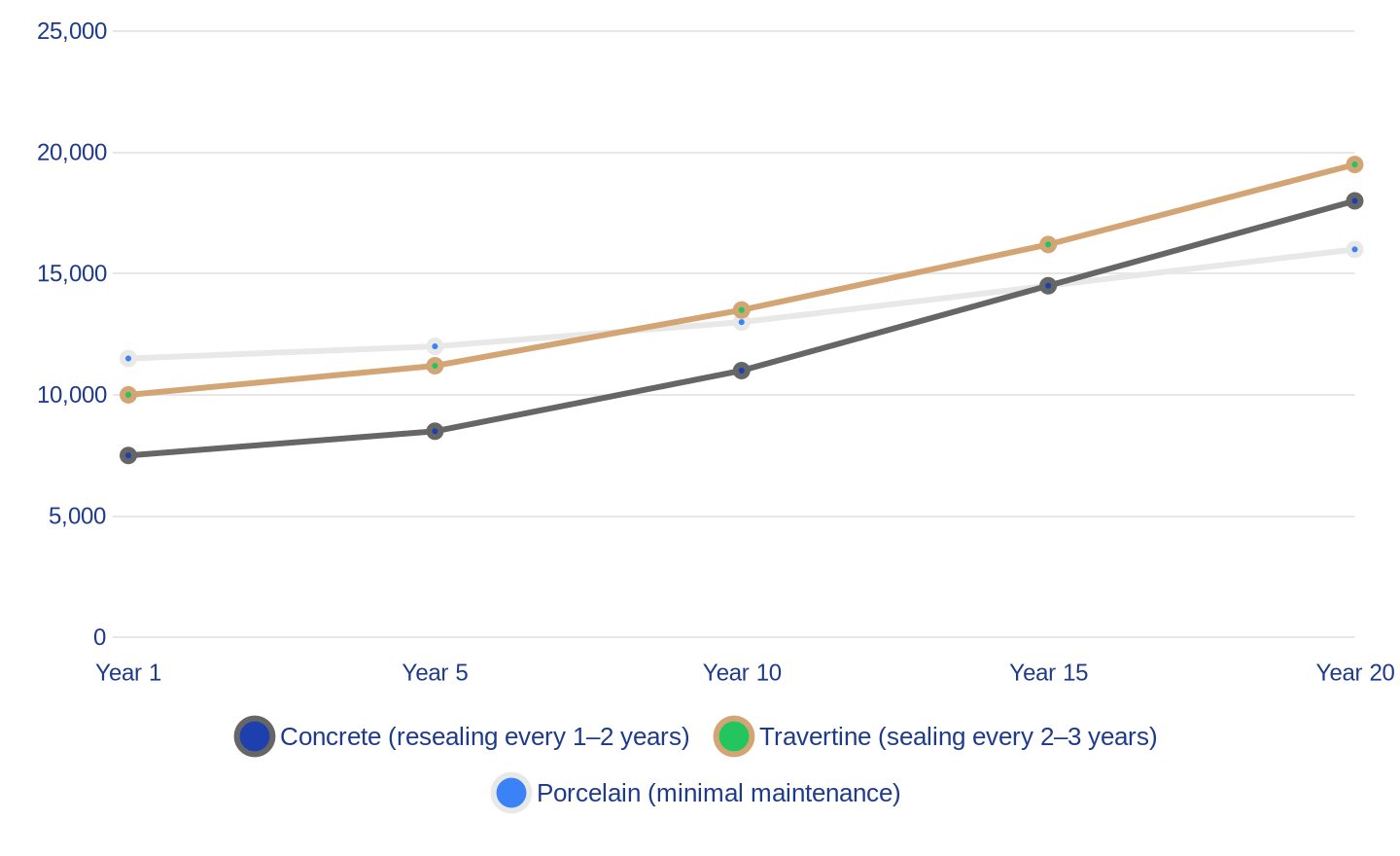
Cumulative cost of ownership (installation + 20-year maintenance) for a 500 sq ft deck in North Port: porcelain's upfront premium is offset by near-zero maintenance, while concrete's low entry cost is eroded by frequent resealing. Travertine balances upfront cost and maintenance burden.
- DIY sealing is possible but risky: improper application traps moisture or creates slippery surfaces. Hire a professional every 2–3 years if using travertine or concrete; $300–$600 is worth the insurance against safety and durability issues.
- Algae growth accelerates on unsealed surfaces and textured porcelain; if your deck is in full sun and away from pool chemical drift, algae pressure is low. Shaded or wind-protected decks experience faster algae accumulation.
- Cracked or chipped pavers can be replaced individually (concrete, travertine, porcelain) but requires matching color and finish. Budget $500–$1,500 for a single-paver replacement if that paver is no longer in stock.
try this: Try it yourself: Get a maintenance contract quote from your installer before signing the paver agreement. Lock in annual sealing or pressure-washing rates now (typically $200–$400/year for travertine or concrete); prices are more favorable when bid together with installation and give you predictable long-term costs.
A Real North Port Example: When Concrete Savings Don't Hold Up
Sarah, a North Port homeowner with a 600 sq ft pool deck facing direct western sun, initially planned concrete pavers to save $3,000 upfront. Her contractor warned that dark concrete would exceed 140°F in summer and that her westward exposure meant algae blooms every three to four weeks without constant maintenance.
Sarah switched to light travertine (+$4,800 upfront) with a 2-year resealing contract at $600/year. Over 15 years, her all-in cost came to $18,600 versus an estimated $16,800 for concrete with aggressive sealing—a $1,800 premium offset by comfort, zero algae stress, and a deck that still looks new at resale.

A light-colored travertine pool deck with warm beige tones, freshly installed, beside a residential pool in bright afternoon sunlight.
What This Means for Different North Port Homeowners
- Homeowners planning new pool decks should request thermal imaging and slip-resistance testing of candidate materials before committing. This 30-minute investment prevents $15,000+ in premature replacement.
- HOA boards and property managers should mandate travertine or porcelain for new decks and renovation budgets, trading $3,000–$5,000 upfront premium for 40–50% reduction in 10-year maintenance costs and liability risk from heat-related slip incidents.
- Contractors should emphasize substrate prep and drainage as heavily as material selection; a $15,000 deck on a $2,000 substrate repair is a recipe for 5-year failure and warranty claims. Transparent itemization builds client trust.
- Coastal North Port properties (within 2 miles of Myakka River estuary or Gulf access) should prioritize travertine or porcelain over concrete due to salt-spray acceleration of concrete efflorescence and spalling.
- Resale value: homes with high-quality travertine or porcelain pool decks command 3–5% higher asking prices in the North Port–Sarasota market; concrete decks are viewed as deferred maintenance.
Keep Learning
- Concrete Pool Construction Near Me: Complete Sarasota-Bradenton Guide — Understand the full pool construction process, including deck layout and substrate requirements, before pavers go in. This guide covers permitting, concrete work, and how deck design integrates with pool shell integrity.
- Pool Resurfacing in Venice, FL: Finishes, Costs & Complete Guide — Explores pool shell finishes (plaster, aggregate, tile) that coordinate with paver selections. Deck material choice affects overall aesthetic and long-term pool durability; learn how they work together.
- Aluminum Pool Enclosure in Bradenton: Materials, Wind Codes & Installation Guide — After your deck is complete, pool enclosures protect your deck investment from debris and intense sun. Learn how enclosure materials complement paver choices and extend deck lifespan in Southwest Florida.
- Pool Cage Rust Repair in Lakewood Ranch: A Complete Diagnosis & Fix Guide — Enclosure maintenance prevents debris accumulation on decks. This guide shows how proper cage upkeep reduces algae and staining pressure on your paver investment.
- Pool Screen Repair Cost in North Port, FL: 2026 Price Guide — North Port-specific permitting, contractor vetting, and cost benchmarking for pool structures. Use the same contractor-selection framework (insurance, references, permits) for deck work as for screen repair.
Frequently Asked Questions
What is the best paver material for a pool deck in North Port, Florida?
Travertine is generally the best all-around choice for pool deck pavers in North Port because it stays cooler underfoot, resists slips naturally without certification, and holds up well against salt exposure. Porcelain is a strong alternative if minimal maintenance and a modern look matter more to you than upfront cost.
How much do pool deck pavers cost to install in North Port?
Installed costs in the Sarasota–North Port area run $13–$16/sq ft for concrete, $20–$26/sq ft for travertine, and $22–$32/sq ft for porcelain as of 2026. The final price depends on deck size, substrate condition, pattern complexity, and whether old decking needs to be removed first.
Can I use dark-colored pavers around my North Port pool?
You can, but dark pavers—whether concrete, travertine, or porcelain—will exceed 135°F on a hot summer day and create a real barefoot burn risk. Most contractors recommend light gray, tan, cream, or beige tones specifically to keep surface temperatures in a safe, comfortable range.
Does Florida code require special permits for pool deck paver installation?
Yes. North Port requires permits before deck work begins, with typical review turnaround of 5–7 days and fees of $300–$600. Inspectors will also verify nonabsorbent materials, slip-resistance ratings, and proper slope for drainage.
How often do pool deck pavers need to be resealed?
Concrete pavers typically need resealing every 1–2 years, travertine every 2–3 years, and porcelain doesn't require sealing at all since it's non-porous. Skipping sealing schedules is one of the most common causes of premature cracking, staining, and algae growth in Florida's climate.