Metal Roofing in Florida: A Homeowner's Material Guide
A guide for Sarasota & Manatee homeowners on metal roofing. Compare standing seam vs. exposed fastener, learn how aluminum & steel perform in FL's heat & hurricanes, and see installation steps.
Metal Roofing in Florida: A Homeowner's Material Guide
Metal roofing has become the standard for hurricane-resistant, energy-efficient homes across Sarasota and Manatee County. But "metal roof" is a broad category: the system you choose, the material composition, and how it's installed will determine whether your investment delivers four decades of peace of mind or becomes a maintenance headache. This guide walks you through the material science, system types, and installation realities so you can make a decision rooted in Florida's specific climate, not just marketing claims.
Most Florida homeowners assume a roof is just a roof. But metal roofing is an engineered system designed specifically for your state's brutal combination of UV heat, salt-air corrosion, hurricane-force winds, and torrential rain. Understanding the material choices and installation rigor required can save you thousands in energy costs and insurance premiums over the decades you'll own your home. The choice between standing seam and exposed-fastener metal roofing — and between aluminum and steel — isn't about aesthetics. It's a physics and durability calculation that directly impacts how your home performs on the Gulf Coast for the next 50-plus years.
The Questions Every Florida Homeowner Asks Before Going Metal
- What's the real difference between standing seam and exposed-fastener metal roofing in Florida's heat and humidity?
- Should I choose aluminum or steel for a coastal Sarasota home, and why does material composition matter for salt-air resistance?
- How exactly does a metal roof lower my cooling costs and insurance premiums, and what numbers should I expect?
- What does proper metal roof installation in Florida actually look like, and why do permitting and deck prep matter for hurricane readiness?
Key Findings
- Metal roofing is engineered as a complete system — not just panels — with hidden fasteners, underlayment, flashing, and deck preparation all working together to resist 140–180 mph winds and heavy rain intrusion.
- Standing seam systems (concealed fasteners) require less maintenance and offer superior weathertightness; exposed-fastener systems (5V-crimp, R-panels) are budget-friendly but need periodic rubber-washer replacement as the Florida sun degrades them.
- Aluminum is the coastal choice for Sarasota and Manatee County because it resists salt-air corrosion naturally; Galvalume-coated steel works for inland properties but requires protective measures in salt-spray zones.
- Cool roof physics: metal's high solar reflectance (60–70%) bounces heat away, directly lowering attic temperatures and reducing cooling costs by 10–25% compared to heat-absorbing asphalt shingles.
- A properly installed metal roof lasts 40–70 years — two to three times longer than asphalt shingles — and recovers 60–85% of installation cost in resale value, often paired with homeowners insurance discounts of 5–35%.
stat callout: 50 Metal roofs in Florida last 40–70 years, requiring only one replacement cycle in a lifetime—versus three to five for asphalt shingles.
Methodology
This guide synthesizes Florida Building Code requirements, coastal wind-rating engineering standards, material science on reflectance and corrosion resistance, and real-world installation protocols used by licensed roofing contractors in Sarasota and Manatee County. Data on lifespan, energy savings, insurance discounts, and resale recovery come from industry consolidation and homeowner case studies specific to Florida's climate. We prioritize practical, measurable guidance over generic roofing advice, because metal roofing in a subtropical hurricane zone is fundamentally different from metal roofing in Arizona or Ohio.
1. Why Metal Roofing Matters for Florida Homeowners: The Climate Case
Florida's climate is not forgiving. Coastal salt spray corrodes unprotected metals, UV radiation breaks down sealants and fasteners, intense heat creates thermal stress on building materials, and hurricane-force winds test the structural integrity of every roofing system on the Gulf Coast. A roof that performs well in a milder climate can fail within a decade here — not because it's a bad product, but because it was never designed for this particular combination of stressors.
Asphalt shingles illustrate the problem clearly. Under Florida's sun, they typically degrade within 15 to 25 years, and they fail catastrophically — not gradually — when hurricane-force wind gets under a tab and starts peeling. Metal roofing, by contrast, is engineered as a complete system rated for decades of service and for wind loads that match or exceed Category 5 hurricane speeds. It's worth remembering, too, that how storm damage occurs to inadequate roofing is almost always a story about wind finding a weak point — a lifted shingle edge, an undersized fastener, a gap in flashing. Metal systems are built to eliminate those weak points from the start.
There's a useful analogy here. Think of asphalt shingles like a car that needs an oil change every 3,000 miles — manageable, but repetitive, and the costs add up over the life of the vehicle. Metal roofing is more like buying a premium engine built to run for 500,000 miles with minimal upkeep. You pay more upfront, but you eliminate the cycle of recurring replacements, insurance risk, and unexpected failures. In Florida's climate, that premium buys you genuine peace of mind — and real savings over time.
Metal's reflective properties also work directly against Florida heat. Unlike dark asphalt, which absorbs solar energy and radiates it into your attic all afternoon, a metal surface bounces a significant share of solar radiation back toward the sky instead of storing it. That single property — reflectance — is the foundation for everything from lower cooling bills to a more comfortable attic. None of this makes metal roofing a luxury upgrade. It's a climate-appropriate choice backed by energy savings, insurance incentives, and straightforward durability math.
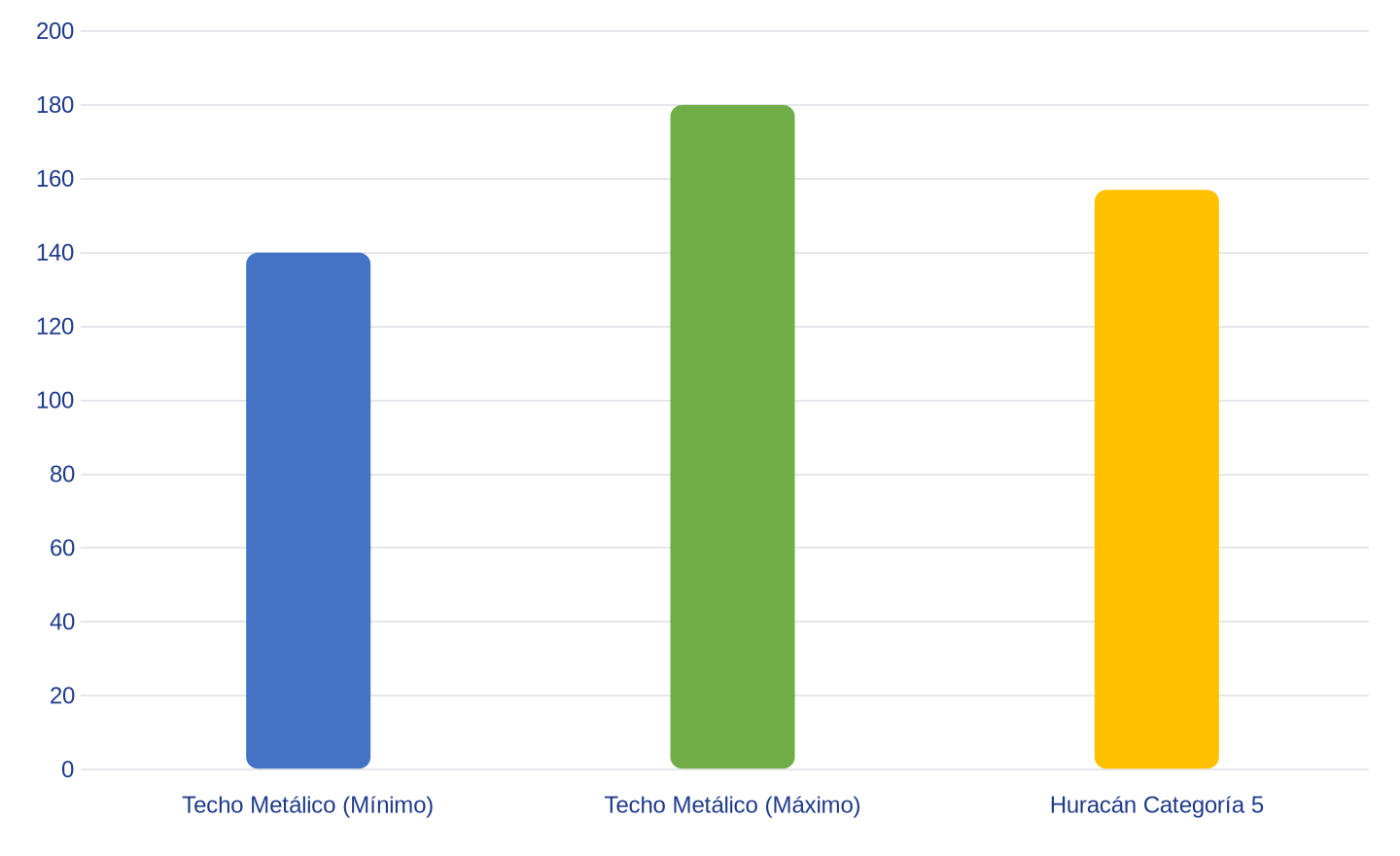
Certified metal roofing systems withstand winds that match or exceed Category 5 hurricane speeds, engineered to meet Florida's most rigorous building codes.
- Metal roofs reduce cooling costs by 10–25% by reflecting rather than absorbing solar heat.
- Properly installed metal roofing systems meet or exceed Florida's most stringent wind ratings (140–180 mph).
- A metal roof lasts 40–70 years in Florida, compared to 15–25 years for asphalt shingles.
try this: Pruébalo tú mismo: Request a professional roof inspection from a licensed Florida contractor. Most offer free inspections and can show you the current condition of your deck, fasteners, and flashing — this data is critical before committing to a metal roof. Learn how to find the right residential roofer near you .
2. Standing Seam vs. Exposed-Fastener Metal Roofs: System Comparison for Florida
Not all metal roofs are built the same way, and the system matters as much as the material. A standing seam metal roof uses vertical ribs with fasteners concealed inside the seams. The panel interlocks with its neighbor, creating a continuous weather barrier that can expand and contract with temperature swings without opening a single penetration point to the elements.
Exposed-fastener systems — the 5V-crimp and R-panel profiles common on agricultural buildings and budget residential jobs — work differently. Screws go straight through the panel into the deck, each one sealed by a small rubber washer. That washer is the entire waterproofing strategy at every fastener point, and in Florida's intense UV and heat, rubber degrades faster than it does almost anywhere else in the country.
In Florida's salt spray and humidity, that rubber degradation accelerates even more. A hidden-fastener system eliminates this weak point entirely, which is why standing seam has become something close to the default recommendation for coastal properties. The cost-versus-longevity math is straightforward: standing seam costs more upfront but requires far less maintenance and typically lasts longer; exposed-fastener is cheaper to install but demands ongoing homeowner vigilance. For coastal Sarasota and Manatee County, standing seam is generally the stronger long-term bet; inland properties may find exposed-fastener acceptable if the owner commits to scheduled fastener inspections.
| Criterion | Standing Seam | Exposed-Fastener (5V-Crimp / R-Panel) |
|---|---|---|
| Fastener Type | Concealed (hidden inside ribs) | Visible screws with rubber washers |
| Weather Tightness | Superior—sealed at seams, minimal penetration points | Good, but rubber washers degrade in FL sun (5–7 years) |
| Maintenance | Minimal; inspect seams and flashing every 5–10 years | Periodic washer replacement every 5–7 years; inspect for leaks |
| Upfront Cost | Higher (typically 20–30% more than exposed-fastener) | Lower; budget-friendly entry point for metal roofing |
| Lifespan | 40–70 years with proper installation and maintenance | 35–50 years (shorter due to fastener degradation in Florida) |
| Best For | Coastal Sarasota/Manatee; premium durability and minimal maintenance | Inland Florida; lower initial budget; homeowners willing to maintain fasteners |
Standing seam systems offer superior weather resistance and lower maintenance over 40–70 years; exposed-fastener systems are more affordable upfront but require periodic fastener maintenance in Florida's harsh UV environment.
- Standing seam fasteners are hidden, eliminating the Florida sun's direct attack on rubber washers.
- Exposed-fastener systems require washer replacement every 5–7 years due to UV degradation.
- For coastal Sarasota and Manatee County, standing seam is the industry standard for long-term durability.
sidenote: Nota: Why rubber washers fail in Florida: the rubber compound used in exposed-fastener screws is formulated for temperate climates. Florida's 85–95°F-plus attic temperatures and intense UV radiation cause the rubber to harden and crack within five to seven years, losing its waterproofing seal. This is why standing seam's hidden fasteners are a game-changer — no exposed rubber means no UV degradation.
3. Aluminum vs. Steel: Material Selection for Coastal Florida and Salt-Air Resistance
Once you've settled on a system, the next decision is what the panels are actually made of. Aluminum's chemistry makes it inherently resistant to salt-air oxidation. It forms a thin, self-healing oxide layer on its surface that protects the metal underneath, which is exactly why aluminum siding and boat hulls have been a coastal staple for generations.
Steel roofing sheets, by comparison, typically rely on Galvalume — a zinc-aluminum alloy coating applied to the steel to protect it from rust. In coastal Florida, the zinc component sacrifices itself first to protect the steel underneath, but that protective coating eventually wears thin and requires re-application, generally in the 20- to 30-year range for properties exposed to salt spray. Salt spray testing shows aluminum panels surviving far longer without visible corrosion than Galvalume-coated steel exposed to the same conditions near the coast.
Weight is a practical factor too. Aluminum is roughly 40% lighter than steel, which reduces installation labor and structural loading — a real consideration on older homes with decking that wasn't built with a heavier roofing system in mind. Steel's added heft means a contractor needs to verify the deck can handle it before moving forward with a steel roof installation.
The cost equation follows the same pattern as standing seam versus exposed-fastener: aluminum costs more per square upfront but delivers true 40- to 70-year durability in a place like Sarasota. Galvalume steel is cheaper initially but may need a costly re-coating within 20 to 30 years if the property sits near the coast. Location should drive the decision. If your home is within roughly five miles of the coast — Sarasota Bay, Tampa Bay, or Gulf waterfront — aluminum is the no-compromise option. Inland properties in Bradenton or Lakewood Ranch can use steel roofing successfully, provided the coating is inspected and maintained.
| Criterion | Aluminum | Galvalume-Coated Steel |
|---|---|---|
| Corrosion Resistance (Salt Air) | Naturally resistant; no coating required for coastal zones | Requires protective Galvalume coating; degrades over time in salt spray |
| Weight | Lightweight (easier to transport, install, and handle) | Heavier (requires structural support verification) |
| Cost | Higher material cost per square | Lower material cost, but may need re-coating in 20–30 years in coastal areas |
| Maintenance in Coastal Zones | Minimal; occasional cleaning to remove salt residue | Periodic inspection and touch-up of coating; re-coating possible at 20–30 years |
| Lifespan in Sarasota/Manatee | 40–70 years without major corrosion concerns | 35–50 years in coastal zone; longer inland (50–70 years) if coating maintained |
| Best For | Coastal Sarasota, Manatee County; waterfront or salt-spray-exposed properties | Inland Florida; properties 10+ miles from coast where salt spray is minimal |
Aluminum is the natural choice for coastal properties because it resists salt-air corrosion without additional coatings; steel requires protective measures in coastal zones and eventual re-coating.
- Aluminum requires no protective coating and naturally resists salt-air corrosion — ideal for Sarasota waterfront and coastal Manatee County.
- Galvalume steel is more affordable but needs protective coating maintenance every 20–30 years in coastal zones.
- Aluminum panels are lightweight, reducing installation labor and structural load; steel panels are heavier and require deck verification.
try this: Pruébalo tú mismo: Compare material quotes from your contractor: ask for both aluminum and Galvalume-coated steel pricing, lifespan estimates for your specific location (coastal vs. inland), and warranty terms. This side-by-side will clarify the upfront cost premium for aluminum versus the long-term corrosion risk with steel. See how to vet contractors on material selection expertise for coastal properties .
4. Metal Roofing as a Cool Roof: How Solar Reflectance Cuts Cooling Costs by 10–25%
The term "cool roof" sounds like marketing, but it describes a measurable physical property: solar reflectance. Dark asphalt shingles absorb 85–95% of the solar radiation that hits them and convert it to heat. Reflective metal roofing panels flip that ratio, reflecting 60–70% of that energy back toward the sky and absorbing only 30–40%.
That difference shows up directly in attic temperature. Under identical sun conditions, an attic under asphalt shingles can climb to 160–180°F, while an attic under a metal roof typically stays 30–50°F cooler. That's not a cosmetic difference — it's the thermal load your air-conditioning system has to fight every single afternoon. When the attic above your ductwork and insulation runs cooler, your compressor cycles less often, your electricity use drops, and your monthly bill reflects it.
Florida's flat, intense midday sun — especially from May through September — maximizes this reflectance benefit, because sunlight hits a metal roof nearly perpendicularly for hours at a time, optimizing the bounce-back effect. The 10–25% savings range reflects real variability: homes with older, less-efficient AC systems tend to see the larger percentage reductions, while newer, high-SEER systems see more modest percentage gains but still benefit in absolute terms. Actual results depend on roof pitch, attic insulation levels, and how the household uses its cooling system.
There's also a compounding effect worth understanding. As asphalt shingles oxidize and darken over their first five to ten years, their reflectance declines further, making them absorb even more heat over time. Metal roofing maintains its reflectance for decades, which means the efficiency gap between the two materials actually widens as both roofs age.
stat callout: 17.5 Metal's high solar reflectance (60–70%) bounces heat away, directly reducing attic temperature and lowering air-conditioning runtime in Florida's intense heat.
- Metal roofs reflect 60–70% of solar radiation; asphalt shingles absorb 85–95%.
- Attic temperatures under a metal roof are 30–50°F cooler than under asphalt, reducing AC load.
- Cumulative savings over 40+ years can exceed $10,000 for a typical Sarasota home.
sidenote: Nota: Cool roof tax credit (if applicable): check whether federal or Florida state energy-efficiency tax credits apply to metal roof installation in your tax year. Some years have offered a tax credit for qualified cool roofing materials; this changes with legislation, so consult your accountant or the IRS website before installation.
5. Metal Roof Installation in Florida: Permitting, Deck Prep, Underlayment, and Hurricane-Ready Flashing
The material you pick matters, but installation is where a metal roof actually earns — or fails to earn — its hurricane rating. Inspection and permitting are non-negotiable: the Florida Building Code requires licensed inspections at both the framing and completion stages, and contractors must pull permits specific to your county — Sarasota or Manatee — and pass wind-load verification before the job is considered compliant.
Deck assessment comes next, and it's where hidden problems get caught. Metal roofing demands solid, structurally sound decking underneath it, so a reputable contractor will identify and repair rot, water damage, or inadequately fastened sheathing before a single panel goes down. Skipping this step is one of the most common ways a metal roof project goes wrong later.
Over the repaired deck goes a high-temperature, self-adhesive underlayment — typically a synthetic or rubberized asphalt membrane. This secondary water barrier matters enormously in Florida because torrential, wind-driven rain can push water under panels even on a well-installed roof; the underlayment is what prevents that moisture from becoming rot or mold inside your attic.
Panel fastening has to match engineered specifications exactly. Improper fastener type, spacing, or torque directly weakens the system's wind resistance, which is why experienced crews use pattern-specific guides and torque-limiting tools to keep fastening consistent across the whole roof. Flashing — at edges, penetrations, valleys, and ridges — is arguably the single weakest link in any roofing system, metal or otherwise. In Florida, flashing needs marine-grade sealants, stainless-steel hardware, and a design that sheds water even during 100-plus mph winds and heavy rain. Poor flashing is the single most common cause of interior leaks during storms, even on roofs with excellent panels.
Finally, a proper installation ends with a final inspection that verifies wind-rating compliance, fastener patterns, sealant application, and water shedding. Skipping or rushing this step can void your warranty — and can lead to denied insurance claims if storm damage occurs down the road.
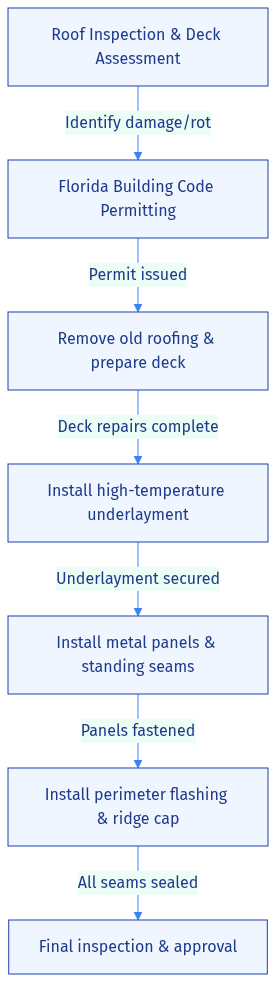
Metal roof installation follows a rigorous sequence in Florida: code compliance, structural prep, waterproofing underlayment, panel installation, and sealed flashing ensure hurricane-ready performance.
- Florida permitting and inspections ensure your roof meets wind-load codes for hurricanes; they are not optional.
- Deck preparation, including rot removal and reinforcement, is where long-term performance is built.
- High-temperature underlayment and properly sealed flashing are the unsung heroes preventing interior water damage during storms.
- Professional installation with engineered fastening patterns and torque control is non-negotiable for a 40+ year lifespan and real wind resistance.
When you're interviewing contractors for this kind of work, it's worth ensuring your contractor follows Florida permitting and installation standards before they ever touch your roof, and verifying licensing and past installation quality with references from recent metal roofing jobs, not just general roofing work.
6. Financial Case for Metal Roofing: Insurance Discounts (5–35%), Resale Value Recovery (60–85%), and Long-Term ROI
Florida insurance carriers treat metal roofs as a lower-risk asset, and they price policies accordingly. Because metal systems generate fewer wind-damage claims and fewer leak claims, most major insurers offer wind-mitigation discounts for homes with qualified metal roofing — typically 5–15% is common, with 20–35% possible for high-wind-rated systems in hurricane-prone zones.
Run the numbers and the discount becomes concrete fast. If your annual premium is $1,200 and you qualify for a 15% discount, that's $180 a year back in your pocket — $1,800 over a decade, and potentially more than $7,000 across the 40-year life of the roof. Resale value tells a similar story: homes with metal roofs in Sarasota and Manatee tend to sell faster and at a premium, because appraisers recognize the durability, energy efficiency, and insurance benefits built into the roof. Homeowners typically recover 60–85% of installation cost — often $8,000 to $15,000 for a 2,000–3,000 square foot home — when they sell.
A real example makes this concrete. A Sarasota Bay-area home built in 1998 with asphalt shingles went through a roof replacement in 2015, after 17 years, at a cost of $6,500. The homeowner chose standing seam aluminum metal roofing instead this time, at a cost of $18,000. By 2024, they had saved roughly $2,400 in insurance discounts (15% on a $1,200 annual premium) and more than $6,000 in reduced cooling costs (a 15% reduction on a $150 monthly AC bill), and the home appraised roughly $12,000 higher than identical neighboring homes still carrying asphalt roofs. Had they chosen asphalt again, they'd already be facing another $8,000 replacement around 2030. Instead, they're on track for another 35-plus years of durability with no replacement in sight.
Break-even math generally lands in the 7- to 10-year range once you combine the insurance discount with the resale premium, on a standing seam roof costing $15,000–$20,000 installed. Everything after that — potentially 30-plus years — is pure financial upside. Add in energy savings: a 15% reduction on a $150 monthly AC bill works out to roughly $270 a year, or more than $10,000 over 40 years, before even accounting for rising energy prices over that span. Compare that to asphalt's reality: a $6,000 replacement every 15–20 years adds up to $18,000–$24,000 in cumulative replacement costs over 60 years, with no resale premium and no insurance discount to offset it.
stat callout: 20 Most major insurers in Florida (State Farm, Homeowners Choice, Universal, Heritage) offer wind-mitigation discounts for metal roofs; actual percentage depends on your county, carrier, and roof rating.
- Insurance discounts alone (5–35%) can save $1,800–$7,000+ over 40 years.
- Resale value recovery of 60–85% means you recoup most of your upfront investment when you sell.
- Cumulative energy savings ($270–$350/year) reach $10,000–$14,000 over the roof's lifespan.
- Total financial upside (insurance + energy + resale) often exceeds installation cost over 40+ years.
sidenote: Nota: Insurance carrier variations: not all carriers offer the same discounts, and some require specific wind-rating certifications, such as Miami-Dade High Velocity Hurricane Zone standards. Call your current insurer before installation to ask what discount applies and what documentation is needed for the claim.
7. Making the Decision: When Metal Roofing Is the Right Choice for Your Sarasota or Manatee Home
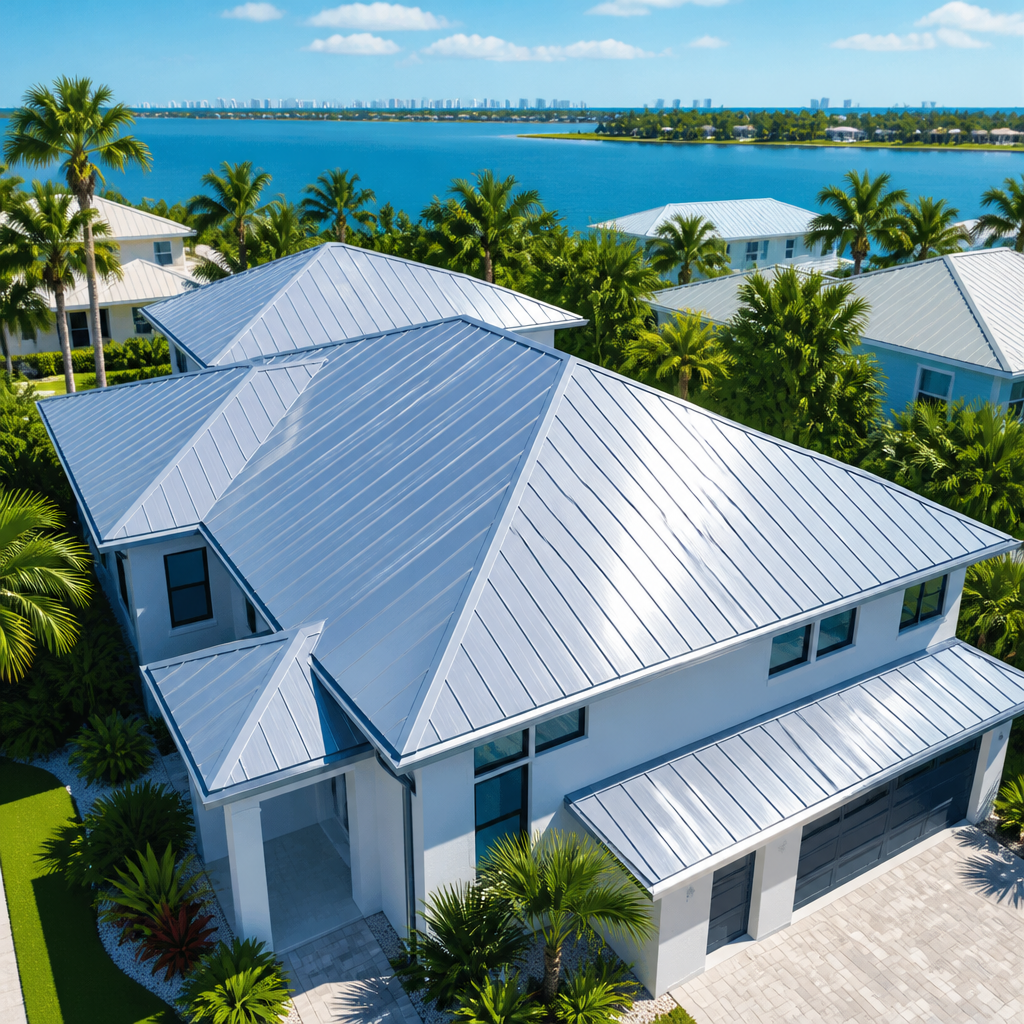
Standing seam metal roofing installed on a Sarasota-area home; the reflective surface bounces intense Florida sunlight, reducing attic heat and cooling costs.
Metal roofing makes the most sense if you plan to stay in your home for 10 or more years, which is roughly the horizon needed to realize the full ROI picture. It's especially compelling if you live in Sarasota or Manatee County, where hurricane risk and coastal salt exposure justify the premium, or if your current asphalt roof is already past 18 years old and approaching the end of its useful life. For many homeowners, the biggest appeal is simply eliminating replacement anxiety for the next 40-plus years.
That said, metal roofing isn't the right fit for everyone. If your budget is extremely tight and financing isn't accessible, or if you plan to move within five to seven years — before the resale premium has fully materialized — asphalt may still make practical sense in the short term. Homeowners far inland with minimal hurricane exposure who are already comfortable managing asphalt's maintenance cycle may also reasonably choose to stay the course.
Location should weigh heavily in the decision. Coastal properties — Sarasota Bay, Gulf waterfront, Manatee County's barrier islands — face enough wind and salt-spray exposure that metal roofing should be a priority, not an afterthought. Interior Bradenton or Lakewood Ranch homes have more flexibility in timing and material choice. Before you commit to a profile or color, check your HOA guidelines: some associations restrict roofing appearance, but metal roofing now comes in enough profiles and finishes — including options that mimic traditional shingles — that most HOA requirements can be satisfied without sacrificing performance.
Financing is also more accessible than many homeowners assume. Because metal roofing increases home value and durability, it can often be financed through a home-equity line of credit, Property Assessed Clean Energy (PACE) programs, or recovered partly through insurance premium reductions over time. If you're ready to move forward, the practical next steps are straightforward: get a professional roof inspection, request insurance quotes that reflect a metal roof, compare standing seam versus exposed-fastener pricing, confirm whether aluminum or steel fits your specific location, and get permits and bids from licensed contractors before committing to a start date.
- Metal roofing is ideal for Sarasota and Manatee homeowners with a 10+ year horizon and exposure to hurricane risk.
- Aluminum is the material choice for coastal properties; Galvalume steel works inland.
- Standing seam is the premium system for long-term durability; exposed-fastener systems are budget-friendly but require maintenance.
- Total financial return (insurance + energy + resale) typically exceeds installation cost over 40+ years.
The clearest next step is simple: get an inspection and a bid from a contractor who routinely does hiring a licensed contractor for a free inspection and quote on metal roofing specifically, not just general repairs. The details — deck condition, correct fastener pattern, flashing design — are exactly where a qualified crew earns its fee.
What This Means for Different Readers
- Homeowners in Sarasota and Manatee County should view metal roofing not as an optional luxury but as a climate-appropriate investment that pays for itself through insurance, energy savings, and resale value — especially for coastal properties.
- HOAs and property managers overseeing multi-unit residential communities can recommend metal roofing to reduce collective insurance risk, lower common-area electricity costs, and extend asset lifespan from 15–25 years to 40–70 years.
- Insurance agents and lenders should educate borrowers about metal roof wind-mitigation discounts early in the purchasing process; this discount often makes a higher-quality roof financially neutral or positive within 7–10 years.
- Contractors and roofers must prioritize proper installation protocols, Florida Building Code compliance, and material selection — aluminum for coastal, Galvalume steel for inland — to ensure the durability and warranty protection that justifies metal roofing's upfront cost.
Frequently Asked Questions
Is metal roofing actually worth the extra cost compared to asphalt shingles in Florida?
For most homeowners planning to stay 10 or more years, yes. When you add insurance discounts, reduced cooling costs, and resale value recovery together, metal roofing's total financial upside often exceeds the installation cost over its 40-plus year lifespan, something asphalt simply cannot match given its 15-to-25-year replacement cycle.
Will a standing seam metal roof actually survive a direct hurricane hit?
Properly installed and permitted standing seam systems are engineered and rated for wind speeds of 140–180 mph, which matches or exceeds Category 5 hurricane wind speeds. The key phrase is "properly installed" — correct fastening patterns, deck prep, and sealed flashing matter as much as the panel rating itself.
Can I install Galvalume steel roofing if I live near Sarasota Bay or the Gulf?
You can, but it's not the recommended choice for waterfront or heavy salt-spray exposure. Aluminum resists salt-air corrosion naturally, while Galvalume-coated steel requires protective coating maintenance and may need re-coating within 20 to 30 years in a coastal zone. If you're within about five miles of the coast, aluminum is generally the safer long-term bet.
How much maintenance does a metal roof actually require?
Standing seam systems need minimal upkeep — mainly a visual inspection of seams and flashing every five to ten years. Exposed-fastener systems need more attention, since the rubber washers under each screw typically harden and need replacement every five to seven years under Florida's sun.
Does installing a metal roof guarantee an insurance discount?
Not automatically — the discount depends on your carrier, county, and the specific wind rating of your installed system, and some insurers require documentation like a wind-mitigation inspection. Call your insurer before installation to confirm what discount applies and what paperwork they'll need afterward.
Keep Learning
- Residential Roofers Near Me in Sarasota & Manatee County: What Sets Them Apart — Dive deeper into how to vet local contractors, check licensing, and understand what separates a roofing crew that knows Florida permitting and HOA compliance from one that doesn't.
- Top Roofers Near Me in Sarasota & Manatee County: How to Vet Local Contractors — A detailed checklist for evaluating contractors' experience with metal roofing installations, wind ratings, insurance claims, and material selection in your specific county.
- Storm Damage Roof Repair Near Me: Sarasota & Manatee County Homeowner's Guide — Learn how metal roofing systems resist storm damage and what to do if your roof sustains impact or wind damage; includes guidance on insurance documentation and claim navigation.
- Roof Fixers Near Me: A Pre-Arrival Checklist for a Faster Fix — Practical steps to prepare for a roof inspection or repair visit, including documenting current conditions and asking the right questions about material and maintenance options.