Local SEO Services for Sarasota & Manatee County Growth
Boost your leads in Sarasota & Manatee County with expert local SEO services. We specialize in Google Business Profile optimization and map rankings to drive measurable results for your local business.
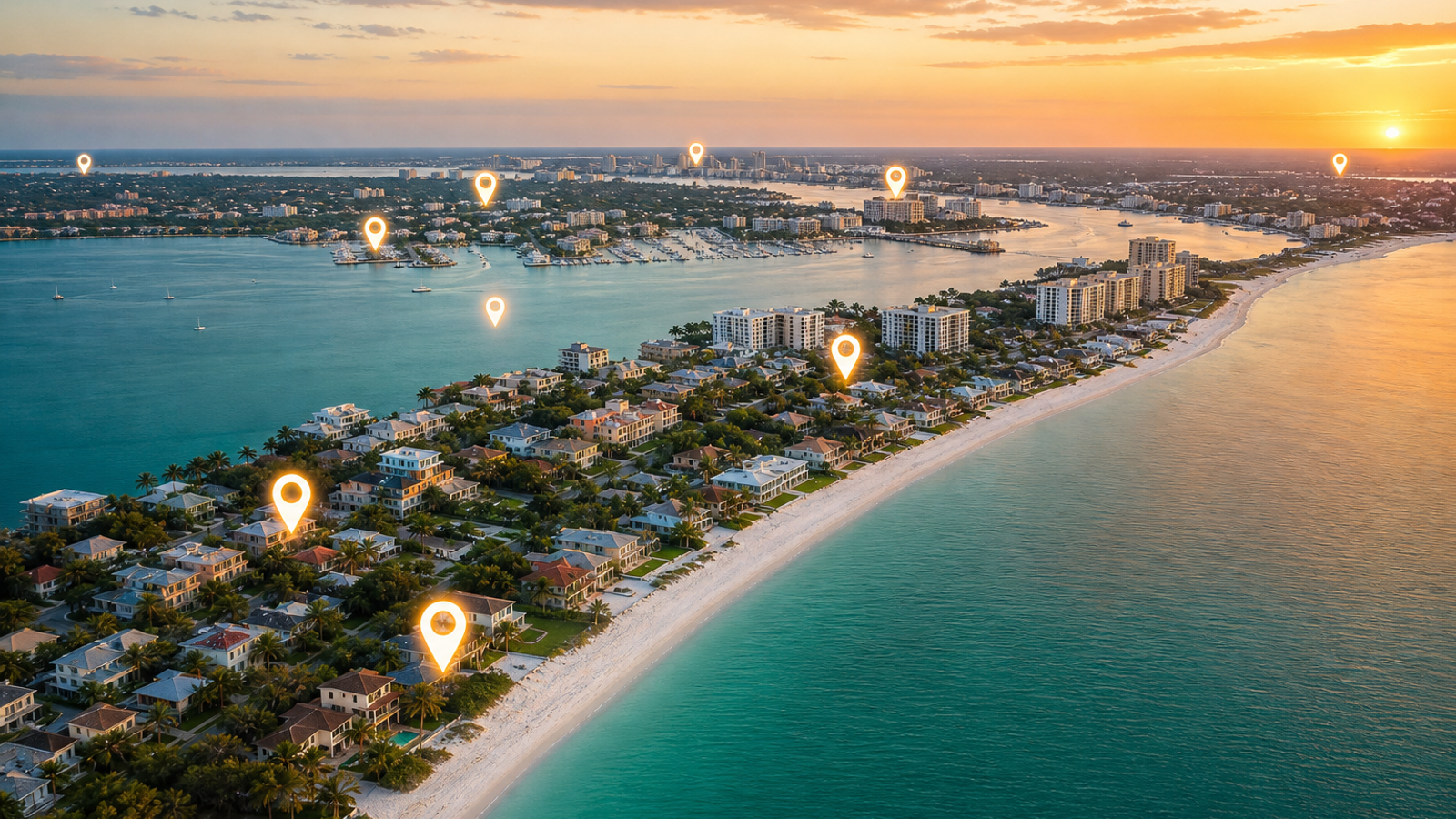
Local SEO Services for Sarasota & Manatee County Growth
A practical, no-fluff guide to dominating the Map Pack, Google Business Profile, and AI-driven local discovery across the Gulf Coast.

Reading time: 9 min
Most Sarasota and Manatee County business owners assume that having a decent website and running a few Google Ads is enough to capture local customers. It feels logical — you're online, you're paying for clicks, you're showing up somewhere.
The data tells a different story. Nearly half of all Google searches now carry local intent, and the businesses winning the Gulf Coast market aren't the ones with the prettiest homepage — they're the ones dominating the Map Pack, the three-business box that appears above the blue links on every "near me" search.
If you run a home services company in Bradenton, a medical practice in Lakewood Ranch, or a boutique on Main Street Sarasota, your next customer is almost certainly searching for you on a phone, from a couch, with high purchase intent. The question isn't whether local search matters — it's whether your business is structured to appear in that 3-second decision window. This guide breaks down what works for local SEO in Sarasota and Manatee County in 2025, with the verified data, tactics, and priorities you can act on this week.
Questions This Guide Answers
- Why is local SEO more important than national SEO for a Sarasota-based business?
- How long does it realistically take to see ranking and lead results in Manatee County?
- What is the Google Map Pack and why does it disproportionately drive local revenue?
- How do seasonal tourism and snowbird traffic change the local SEO playbook on the Gulf Coast?
Key Findings
- 46% of all Google searches have local intent — meaning nearly half of your potential customers are searching with geographic context.
- 78% of location-based mobile searches end in an offline purchase , making local search one of the highest-ROI marketing channels for brick-and-mortar Gulf Coast businesses.
- A complete Google Business Profile makes customers 2.7x more likely to view your business as reputable — before they ever visit your site.
- Hyperlocal strategies (Sarasota, Bradenton, Lakewood Ranch, Siesta Key) consistently outperform generic statewide SEO because of how Google ranks proximity and relevance signals.
46% of all Google searches are for local information — a massive opportunity for Sarasota and Manatee County businesses.
How We Built This Guide
This guide combines verified industry data on local search behavior with on-the-ground experience optimizing Google Business Profiles, citation portfolios, and locally-targeted content for businesses across Sarasota and Manatee County. We focus on metrics that map to revenue — calls, direction requests, and qualified form fills — rather than vanity traffic numbers. Tactics referenced are aligned with current Google local ranking factors (relevance, distance, prominence) and validated against real campaigns in competitive Gulf Coast verticals like home services, healthcare, and hospitality.
1. Why 46% of Google Searches Are Reshaping Local Demand on the Gulf Coast
"Local intent" is broader than most business owners realize. It's not just the explicit "near me" query. It's also "plumber Lakewood Ranch," "best brunch Siesta Key," "pediatric dentist 34243," or even an implicit search like "AC repair" performed from a phone with location services on. Google interprets all of these as local — and serves results accordingly.
Sarasota and Manatee County happen to be one of the most active local search markets in Florida, and for a specific reason: the population is three populations stacked on top of each other. You have year-round residents who search the way most Americans do. You have snowbirds from November through April who arrive without an established list of providers and Google everything from dentists to dog groomers. And you have a steady stream of tourists who search for restaurants, rentals, and services with extremely high purchase intent.
What does "losing" look like in this market? It's quieter than most owners expect. You don't get a notification when a competitor takes your click. You just slowly notice fewer calls, fewer walk-ins, and a vague sense that "the phone used to ring more." Meanwhile, the business two miles away with a fully built-out Google Business Profile and 40 fresh reviews is quietly absorbing the demand that used to be yours.
The correct frame here is revenue, not rankings. A position-4 listing in the Map Pack isn't a "vanity loss" — it's an invisible listing. Mobile users tap one of the top three results and move on. Every spot you don't own is revenue going to someone else.
Nearly half of every Google search is local — this is the demand pool your business is competing for.
- Local intent isn't just "near me" — it includes searches like "plumber Lakewood Ranch" or "best brunch Siesta Key."
- Seasonality amplifies this: search volume in Sarasota spikes from November through April with the snowbird population.
2. The Google Map Pack: Where 78% of Mobile Local Searches Convert Offline
The Map Pack is the boxed cluster of three local business listings — each with a star rating, hours, and a map pin — that Google places at the very top of a local search result. On mobile, it occupies most of the screen above the fold. On desktop, it sits to the right or above the organic listings. Either way, it's the first thing a searcher sees, and on phones it's often the only thing they engage with.
The reason this matters so much for revenue is simple: 78% of location-based mobile searches result in an offline purchase. Someone searching "tire shop Bradenton" on their phone is not researching — they're buying. They're going to call, get directions, or walk in within the next few hours. If you're not in the top three, you're not in the consideration set.
stat callout: 78 Mobile local search is the closest thing to walk-in traffic the internet has ever produced.
Google decides who appears in the Map Pack using three factors, and you need to be honest about how you stack up on each one:
- Relevance: Does your Google Business Profile and website clearly match what the user searched? Your primary category, services, and on-page content all feed this signal.
- Distance: How close is your business to the searcher (or to the city center implied by the query)? This is largely fixed — you can't move your storefront — but it's why service-area businesses must define their service areas precisely.
- Prominence: How well-known and well-reviewed is your business? Review count, review velocity, citation consistency, and backlinks all roll up here.
To evaluate your own performance, don't just Google yourself from your office. Run rank checks from multiple zip codes across your service area — 34236 (downtown Sarasota), 34202 (Lakewood Ranch), 34209 (west Bradenton), 34242 (Siesta Key). You'll often discover that you rank #2 from your own front door and #8 from three miles away. That's the real picture.
- If you don't rank in the Map Pack for your primary service in your primary city, you're effectively invisible to mobile searchers.
- Map Pack rankings can shift block-by-block — proximity is a major factor, especially in dense areas like downtown Sarasota.
sidenote: Note: Map Pack rankings vary block by block in Sarasota because Google weights proximity heavily. A business in downtown Sarasota may rank #1 when searched from Burns Court but drop to #6 from Lido Key, just a few minutes away. This is why location-based rank tracking — not just "where do I rank?" — is essential for any serious local SEO campaign.
3. Google Business Profile: The 2.7x Reputability Multiplier
A complete Google Business Profile makes customers 2.7x more likely to view your business as reputable — and that judgment happens before they ever click through to your website. It's the storefront for your storefront.
A fully optimized Google Business Profile makes you 2.7x more likely to be seen as a credible business.
"Complete" is doing a lot of work in that sentence. A truly optimized profile has the correct primary category (not a close-but-wrong one), every secondary category that legitimately applies, a full services list with descriptions, accurate hours including holiday overrides, defined service areas if you travel to customers, attributes (wheelchair accessible, women-owned, accepts new patients), an active Q&A section, and a fresh photo library that reflects what the business actually looks like today.
The review engine is where most Sarasota businesses leave the most money on the table. It's not just the star rating — it's the cadence. Google looks at how often new reviews are coming in, how recent they are, and how you respond. A response strategy that thoughtfully references the service performed and the neighborhood ("Thank you, Karen — we're glad the AC tune-up at your Palmer Ranch home went smoothly") quietly reinforces relevance signals. Don't keyword-stuff, but don't write "thanks!" either.
Photos matter more than people think. Google's algorithm and your customers both want current, category-specific imagery — interior shots, team photos, before/afters, products in context. Stock photography is a tell, and it hurts. Upload geo-relevant photos taken on a phone with location services on; the metadata helps.
The most common GBP mistakes I see in Sarasota and Manatee County: a wrong primary category (a "med spa" listed as "spa" loses a huge chunk of medical-aesthetic search), undefined or overly broad service areas, an ignored Q&A section where competitors have left unanswered questions for months, and posts that haven't been updated since the profile was claimed.
- Add a new GBP post weekly — Google rewards active profiles with more impressions.
- Respond to every review within 48 hours, including the negative ones.
sidenote: Note: Review velocity matters more than total review count. A business with 200 reviews from two years ago can be outranked by a competitor with 60 fresh reviews from the last 90 days. Google reads stagnant review profiles as a signal that the business may be less active or less relevant today — even if the historical reputation is strong.
try this: Try it yourself: Audit your own Google Business Profile in ten minutes. Open it on mobile and check four things: (1) Is your primary category the most specific accurate match? (2) Are your hours and service areas current? (3) Add at least 5 new photos taken this month. (4) Respond to your three most recent reviews with specific, neighborhood-aware language. Note any field marked "incomplete" — those are your next priorities.
4. Hyperlocal Citations & NAP Consistency Across Sarasota, Bradenton, and Lakewood Ranch
NAP stands for Name, Address, Phone — and Google uses citations of your NAP across the web as one of the strongest prominence signals it has. The problem is that most established businesses have years of inconsistent listings out there. "Suite 200" vs "Ste. 200." A phone number from before you ported lines. A business name with "LLC" in some places and without in others. Each variation chips away at Google's confidence.

Every consistent citation reinforces Google's confidence in your business — and your local rankings.
For Florida Gulf Coast businesses, the priority citation sources break down into three tiers. The foundational layer is the major data aggregators and platforms: Google Business Profile, Apple Maps, Bing Places, Yelp, Facebook, Yellow Pages, and Foursquare. The second layer is industry-specific — Healthgrades for medical, Avvo for legal, HomeAdvisor and Angi for home services, OpenTable and TripAdvisor for hospitality. The third layer, often overlooked, is the local layer: the Sarasota Chamber of Commerce, the Manatee Chamber, Visit Sarasota, Lakewood Ranch Business Alliance, Siesta Key Chamber, and neighborhood association directories.
That third layer punches above its weight. A citation from the Sarasota Chamber carries a hyperlocal trust signal that a generic national directory simply can't match — and these listings frequently rank for "\[service\] Sarasota" queries themselves, giving you a second bite at the SERP.
To clean up existing citations, start with a free audit tool (Moz Local, BrightLocal, Whitespark) to surface every variation of your NAP currently floating around. Pick one canonical format — exactly how you want your name, address, and phone displayed — and methodically update or claim every listing. This isn't glamorous work, but it's the kind of foundation that determines whether the rest of your local SEO efforts compound or leak.
- Use one canonical address format and stick to it across every platform.
- Industry-specific directories often outperform general ones for ranking impact.
try this: Try it yourself: Run a NAP consistency check right now. Google your business name plus your phone number in quotes, and compare the top 10 results. Flag any listing where the name, address, or phone doesn't match exactly. Those mismatches are your quick wins — usually 30-minute fixes that recover ranking signal you didn't know you were losing.
5. Local Content & "Near Me" Optimization: Capturing 80% Conversion Intent
stat callout: 80 Local search traffic converts at rates national campaigns can only dream of.
Local search converts because the intent is concrete. A user searching "emergency dentist Bradenton Saturday" isn't comparison shopping for a future purchase — they have a problem right now. Your content needs to meet that urgency.
The cornerstone of local content strategy is the location page. If you serve Sarasota, Bradenton, Lakewood Ranch, Siesta Key, and Venice, you need a dedicated page for each — but here's where most businesses fail: they create five near-identical pages that just swap the city name. Google sees that pattern instantly and treats them as thin, duplicate content. They rank for nothing.
A real location page references the actual neighborhood. It mentions the streets you serve, the landmarks nearby ("just off University Parkway near the UTC mall"), the local context that matters ("we handle the salt-air corrosion common to Siesta Key properties"), and includes testimonials or project photos from that specific area. It answers the questions a Bradenton resident would actually ask, which are not identical to the questions a Lakewood Ranch resident would ask.
Voice search and AI Overviews are reshaping how you should write. Voice queries are longer and more conversational — "who's the best plumber near me open right now" instead of "plumber Sarasota." This rewards FAQ-style content with direct, two-to-three-sentence answers. AI Overviews — Google's generative summaries — pull heavily from structured content, clear headings, and pages with strong schema.
Speaking of schema: the markup that matters for local businesses is LocalBusiness (with the correct sub-type for your industry), Service for each offering, FAQ for question-and-answer content, and Review for testimonials. Don't bolt these on as an afterthought. They're how you make your relevance machine-readable to every search system that's about to recommend you — or skip you.
- Each location page should reference real landmarks, neighborhoods, and local context — not just swap the city name.
- AI Overviews increasingly pull from FAQ-style content with clear, direct answers.
sidenote: Note: Google's AI Overviews pull from a mix of high-authority pages, Google Business Profile data, and structured FAQ content. Local businesses with clear, question-formatted content have an outsized advantage here — particularly when the FAQ answers a specific question (hours, service area, pricing range, what to expect) rather than a generic one.
6. What Winning Looks Like: A Lakewood Ranch Home Services Example

A well-executed local SEO campaign turns a service van into a recognizable local brand — and a Map Pack mainstay.
Think of local SEO the way a Gulf Coast captain thinks about fishing. Generic SEO is dropping a net in the open Gulf — you might catch something, but you're competing with everyone for everything. Local SEO is knowing which dock to launch from, which tide is running, and which bait works for the species you actually want. Sarasota and Manatee have their own rhythms — seasonal, neighborhood-specific, intent-driven — and businesses that know the local waters consistently out-fish the ones running a national playbook.
Here's what a realistic 90-day roadmap looks like for a home services company in Lakewood Ranch:
Month 1 — Foundation. Full Google Business Profile overhaul (categories, services, hours, attributes, photos, Q&A seeding). NAP audit and citation cleanup across the top 25 directories. Review request system installed — usually a post-job text message with a direct review link. Schema markup added to the homepage and service pages.
Month 2 — Geographic depth. Build neighborhood-specific location pages for Lakewood Ranch, Bradenton, and Palmetto, each with real local context, testimonials, and service-area schema. Begin local link building through chambers, community sponsorships, and partner referrals. Launch weekly Google Posts featuring recent projects with neighborhood tags.
Month 3 — Compounding. Add FAQ content optimized for voice and AI Overview queries. Maintain the review velocity (target 8–12 new reviews per month). Publish locally-relevant blog content — "what to do when your AC freezes in Lakewood Ranch summer humidity" — and review performance against baseline.
A real Bradenton-based HVAC client ran exactly this play. They invested 90 days in GBP optimization, weekly Google Posts, a structured review request system, and three neighborhood-specific service pages for Bradenton, Lakewood Ranch, and Palmetto. Within a quarter, they moved from position 7–9 in the Map Pack to consistently appearing in the top 3 for their core service queries, with call volume from Google increasing substantially.
The KPIs to track each month are straightforward: Map Pack rank from multiple zip codes, GBP calls, direction requests, profile views, qualified form fills, and — critically — call volume by source. Don't lump all your leads together. You need to know which ones came from Google specifically to prove and refine ROI.
- Most well-executed local SEO campaigns show meaningful Map Pack movement within 60–90 days.
- Track call volume by source — not just total leads — to prove ROI.
7. Future-Proofing: Voice Search, AI Overviews, and the Next Wave of Local Discovery
Local discovery is fragmenting. For two decades, "local SEO" essentially meant Google. Now your prospective customer might ask Siri, talk to Alexa, type a question into ChatGPT, or scroll through a Google AI Overview that summarizes the answer without ever showing your listing. Each of these channels rewards a different layer of your SEO foundation.
| Channel | How Customers Search | What Wins |
|---------|----------------------|-----------|
| Traditional Google Search | "plumber Sarasota" | Map Pack ranking + complete GBP |
| Voice Search | "Hey Google, find a plumber near me open now" | Conversational content + accurate hours + strong reviews |
| AI Overviews / ChatGPT | "What's the best HVAC company in Bradenton?" | Strong reviews + structured FAQ content + brand mentions across the web |
Local discovery is fragmenting across new channels — and each one rewards a different layer of your SEO foundation.
Voice search changes keyword strategy more than people realize. Voice queries are longer, more natural, and almost always question-based. Optimizing for them means writing the way people speak — and structuring content so a voice assistant can extract a clean, spoken answer. FAQ sections, clear H2s framed as questions, and concise opening sentences are the formats that win here.
AI Overviews and tools like ChatGPT are the bigger structural shift. These systems decide which businesses to recommend based on a triangulation of signals: review reputation across multiple platforms, structured content that clearly answers questions, and brand mentions across reputable third-party sites — even when those mentions don't include a link. This last point matters: traditional backlink building is being supplemented by what's effectively digital PR. Getting cited in a Sarasota Magazine roundup, a Herald-Tribune feature, or a local podcast now influences whether AI tools will recommend you at all.
You don't need to overcommit to prepare. Start with two moves: build out an honest FAQ section on your highest-converting service pages, and make sure your review reputation is consistent across Google, Yelp, Facebook, and any industry-specific platform that matters in your vertical. Those two assets do most of the future-proofing work.
- FAQ-rich content is the single highest-leverage asset for AI-driven discovery.
- Brand reputation across review platforms now influences whether AI tools recommend you at all.
What This Means for Your Business
For local business owners and marketing decision-makers in Sarasota and Manatee County, four implications stand out:
- If your Google Business Profile isn't fully optimized, you're leaving the single highest-leverage local SEO asset on the table — and competitors with weaker offerings can outrank you simply by showing up better.
- Manatee County's rapid growth means the local search landscape is getting more competitive every quarter. The cost of waiting is measured in lost calls, not just lost rankings.
- The shift toward voice search and AI-powered recommendations means strong review profiles and structured FAQ content are no longer optional — they're becoming the primary signals AI tools use to recommend local businesses.
- Partnering with a team that understands the specifics of the Sarasota/Manatee market — seasonality, snowbird behavior, neighborhood-level competition — typically delivers faster ROI than a national firm running a generic playbook.
Frequently Asked Questions
How long does local SEO take to produce results in Sarasota and Manatee County?
Most well-executed campaigns show meaningful Map Pack movement within 60–90 days, particularly when the foundation work (GBP optimization, citation cleanup, review velocity) is done correctly in month one. Highly competitive verticals like personal injury law or HVAC may take longer, while less competitive niches can see lift within 30–45 days.
Do I need a separate location page for every city I serve?
Yes, if you genuinely serve those cities and can write substantive, unique content for each. A Sarasota, Bradenton, and Lakewood Ranch page that each reference real neighborhoods, landmarks, and local context will outperform a single generic "service areas" page. What you don't want is five near-identical pages with the city name swapped — Google treats those as thin content and they hurt more than they help.
How important are Google reviews compared to other ranking factors?
Reviews are one of the top three local ranking signals, especially when you weight both quantity and velocity. A steady stream of recent, detailed reviews almost always outperforms a stagnant pile of older ones. Reviews also feed AI Overview recommendations, so their influence is growing, not shrinking.
Should I run Google Ads while doing local SEO?
For most local businesses, yes — at least initially. Google Ads delivers immediate visibility while organic local SEO compounds over 60–90 days. Once Map Pack rankings stabilize, many businesses scale ad spend down and reinvest in content and review acquisition, because organic leads typically cost less per acquisition than paid ones.
What's the single biggest mistake local businesses make on the Gulf Coast?
Treating their Google Business Profile as a "set it and forget it" listing. The businesses winning the Map Pack in Sarasota and Manatee County are the ones posting weekly, responding to every review, refreshing photos monthly, and keeping hours and services accurate. The profile is a living asset, and Google rewards activity.